Kele Blog

COVID-19 Testing for UV Disinfection Solutions

Kele supplier Fresh-Aire UV shares results

Last month, Kele introduced a new Disinfection Solutions product category featuring ultraviolet (UV) sanitation fixtures. Kele now offers solutions from leading HVAC UV disinfection suppliers Fresh-Aire UV and PURO. Their high-intensity UV fixtures are highly effective against bacteria and viruses.

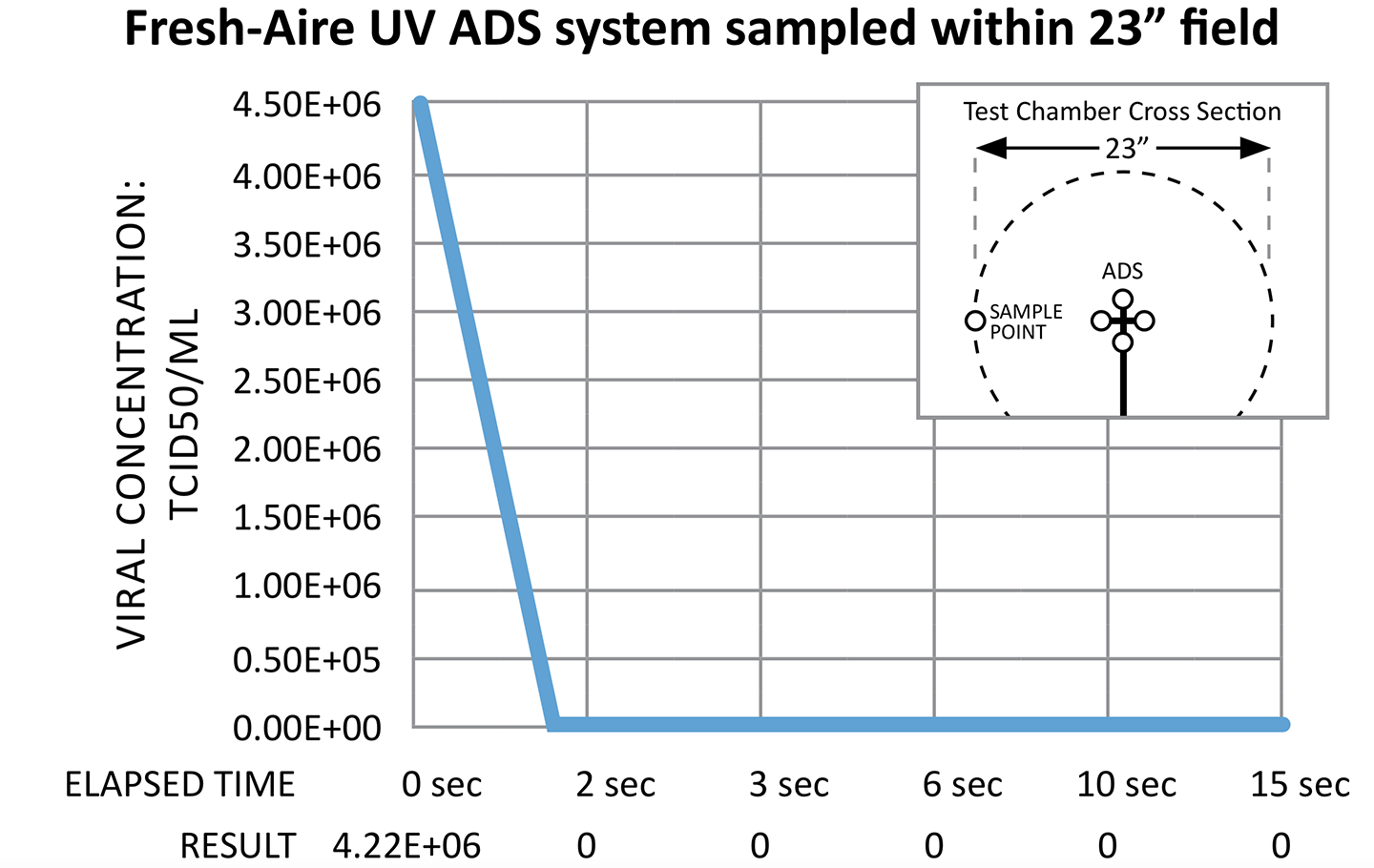
Fresh-Aire UV recently shared the results from its phase-1, third-party testing of the effectiveness of its products against SARS-CoV-2 (the virus that causes COVID-19). The test includes Fresh-Airer UV’s residential, commercial, and healthcare. In the test report titled “SARS-CoV-2 Neutralization by Germicidal UV Light System from Fresh-Aire UV,” the systems delivered greater than 4-log inactivation (>99.99%) on the SARS-CoV-2 virus within 0-2 seconds of exposure to Fresh-Aire UV UVC 254nm light systems.

Inactivates >99.99% of Sars-Cov-2 within 0-2 Seconds!

The testing was conducted by California-based Innovative Bioanalysis a CAP-, CLIA-, and AABB-certified laboratory. The test was designed to model exposure time comparative to inactivating the SARS-CoV-2 virus in the moving airstream within the HVAC or ventilation system. Products tested were the Fresh-Aire UV ADSTM (duct-mounted airborne disinfection) for commercial and healthcare applications, Blue-Tube XLTM (HVAC coil and airborne disinfection) for commercial and healthcare applications, and APCO-XTM (HVAC coil and airborne disinfection with VOC/odor reduction) for both residential and commercial applications. Phase-2 testing is currently underway.
“Fresh-Aire UV has been manufacturing proprietary germicidal UV systems for 20 years, and with everything we know about the SARS-CoV-2 virus combined with our testing experience, we were confident our systems would be very effective at inactivating the virus.” according to Aaron Engel, Vice-President of Business Development at Fresh-Aire UV. “We now have independent verification of the successful inactivation of the SARS COVID-19 virus and an even better understanding of how well our disinfection systems perform within the HVAC system, ductwork, and on surfaces.”

Since the onset of the COVID-19 pandemic, Fresh-Aire UV has been providing UV system recommendations for residential, educational, commercial, and healthcare facilities. Fresh-Aire UV systems were also used in the FDA-sponsored testing of UVC’s ability to disinfect and extend the life of N95 masks as published in the American Journal of Infection Control.

Kele is proud to offer Fresh-Aire UV products in its new Disinfection Solutions line. The phase-1 test results further validate its inclusion. Kele has inventory in stock and is ready to work with you to find the solution you need and get product to you ASAP. Our technical service team is also available to help you through any issue. Shop now, call your Kele sales rep, or Live Chat on kele.com.


Monitor CO2 to Keep Buildings Safe and Operational This Season

Monitoring carbon dioxide (CO2) is not a new concept for building automation and HVAC contractors. However, this task has entered the spotlight for a new reason: COVID-19. CO2 levels may be a relevant indicator of the potential presence of virial particles in the air.

With concerns about COVID-19 steadily continuing to grow, especially as we enter the holiday season, many customers continue to face the challenge of how to minimize the spread before it can wreak havoc in their buildings. Balancing safety and health with cost-effective solutions can sometimes feel impossible from your customer’s perspective. But as a contractor, being able to deliver both is paramount. CO2 monitoring is one important, and accessible, step.

In fact, a Virginia gym owner did just that. She prioritized safety and health for the members of her gym by working closely with one of her members who is a professor of civil and environmental engineering. Since the owner built the gym herself, she had all the engineering and HVAC documents to outfit her entire space following AHSRAE’s safety precautions.

She found out her hard work paid off after a trainer tested positive for COVID-19 and potentially exposed 50 athletes. Because of her precautions, not a single athlete contracted the virus. So, what did she do? She followed ASHRAE guidelines and calculated how much fresh air via ventilation was needed based on the building’s CO2 detector readings. She increased the amount of ventilation in her gym and kept strict watch over the CO2 sensors/detectors.

This goes to show just how important it is to have effective ventilation and CO2 sensors. Gauging occupancy is important in keeping your customers and their buildings safe and able to operate. It also lets your customer adjust their ventilation needs based on occupancy and therefore save money when occupancy levels coincide with lower levels of fresh air being needed.

An investment on the front end, while sometimes expensive, can help save money in the long run and help keep safety and health first. Two solid options are the Kele brand KCD Series and KCO2 Series. The KCD Series is great for a tight budget and has analog output only, whereas the KCO2 Series is a tad higher end due to its optional relay output, which is used in standalone applications where there may not be an automation system. The onboard relay is what opens or closes the damper (as opposed to the automation system).

Kele can help you regardless of your or your customer’s budget, and we offer a wide variety of high-performing CO2 sensors from several trusted brands in addition to the KDC or KCO2 if they don’t fit your needs. Call our sales team or technical service representatives today or browse our CO2 category on kele.com. (You can even chat with us via our Live Chat.) Kele can get you the parts necessary to help your customers keep their buildings safe and operational.


Bringing in More Outside Air in Cold Weather Months

Between battling summer temperatures and COVID-19 concerns, HVAC systems have been running full throttle for months on end now. Many customers began bringing in more outside air to combat germs and keep fresh air prevalent in buildings. (We discussed how outside air is critical for your building in August. With temperatures falling and more and more customers facing colder conditions, it’s time to fully embrace the heating season, and give your customers’ systems the TLC they need, and consider how more outside air may affect your plan.

Typically, heating air takes place by air blowing across a heat exchanger and therefore gaining heat. It is then funneled through a system of ducts and distributed throughout the system. This means that the colder it is outside, the harder the system is going to work to heat the air that it is drawing from. So, what does this mean for outside air (OSA) intake?

Your customers may think that OSA intake changes as seasons come and go but they need to know that it doesn’t. However, conditions do. In most of the country, unless you live in a climate with a constant temperature, your customers enjoy a brief reprieve as seasons change where they can open windows, which equates to free economizing. All the air being brought in via the OSA dampers is just right to meet the customer’s needs. Now that it needs to be heated though, it may be more cost-effective for, say, a customer in Atlanta rather than a customer located in Fargo.

So, it’s critical to make sure that each part of the system is running without fail and that any necessary repairs or retrofits be done sooner rather than later if you want to stay ahead of winter weather. You want to help keep costs down and retrofits minimal so that heating season doesn’t turn into a huge cost year after year for those who are already paying more to heat their air. As always, it’s important to inspect the following components before Old Man Winter gets here:

A few specific parts you may want to have on hand are 12-25-ft. averaging sensors, 12-ft.+ low limit switches, capillary clips to go with both, and don’t forget the new UV disinfection solutions Kele now offers.

Don’t hesitate to run a system/maintenance check to make sure that everything is running as it should! With the increased intake of OSA and colder conditions, preventative maintenance is a must. Advise your customers to be proactive rather than reactive because no one wants to be without heat when Jack Frost is nipping at their nose. Your customers’ systems need to be in tip-top shape to fight off colder temperatures and the adjustment that all systems go through when seasonal change hits.

Kele is here for all your HVAC needs to get you and your customers through this winter season. Call us or use our live chat today and get what you need to succeed and keep that winter weather at bay.

UV Disinfection in HVAC

Germs. Tiny little microorganisms that wreak so much havoc in your customers’ buildings when left unchecked. Now, more than ever, your customers are faced with keeping surfaces and areas safe thorough cleaning. But that leads to the question of how to clean and disinfect things that aren’t easily reached, such as the rarely seen inside of HVAC systems.

Disinfection is termed as being a process that eliminates all or a majority of pathogenic microorganisms on inanimate objects. The sense of urgency in keeping buildings—i.e. hospitals, restaurants, warehouses, schools/universities, etc., germ and virus-free, may be the biggest day-to-day headache all of your customers are currently facing.

Ultraviolet disinfection, to be exact, is how the industry is making strides in the current climate. So, let’s break down how it works in regard to HVAC and how easy it can be for you to implement so that your customers see the value. Ultraviolet germicidal radiation is mainly used to sterilize equipment and has actually been used to treat water since as far back as 1909. UV disinfection doesn’t truly kill microorganisms but through exposure to the radiation, renders them inactive through sterilization.

This ultraviolet radiation will kill a variety of harmful organic buildup in an HVAC system’s ducts and coils. By purifying the air or coils as the microorganisms pass by, you’re able to target specific areas and keep system additions and/or retrofits minimal, which makes every project as cost-efficient as possible. Coil Sanitizing Lights or Air Sanitizing Lights are two options and typically have a low installation cost. They fit in seamlessly with other system aspects and add another level of protection for those that are within said system’s vicinity.

By partnering with Kele, we make it easy for you to meet your customers’ needs. Kele now offers innovative UV disinfectant products from Fresh-Aire UV and Puro that can kill up to 99.9% of bacteria and viruses when used at the recommended spacing and runtimes. And with our tech service team—setup and troubleshooting has never been easier to work through. We’re here to help!

Chat with a sales rep. today through our live chat on kele.com or by phone so that we can get you the parts you’ll need to knock it out of the park on your next project.

Maintain Correct Humidity Levels No Matter What

Being based in Memphis, Tenn., where the humidity feels lethal, Kele knows firsthand how important it is to not only conduct checks on your equipment but to also install the best parts to monitor your systems. Sometimes, you need to increase humidity (something you don’t typically hear in the South). When you mix too much or, yes, too little humidity into the equation, things get dicey. Keeping humidity at bay can be difficult and maintaining a good amount even more so, but when you have the right parts to know where your system and environment stand, the difficulty lessens.

Duct humidity sensors are a system’s best friend when regulating humidity. A hygrometer, or humidity sensor, measures, senses, and reports both air temperatures and moisture. It can be the difference between an HVAC system that is bogged down by too much moisture and one that is operating at peak performance. Most of us are familiar with the negative impact of too much humidity—uncomfortable work environment, equipment failure, etc.

Too little humidity can not only affect the health of your system, but also the building’s and possibly yours! It’s all about finding the happy medium and giving your system enough moisture to thrive while also starving it just enough to keep numerous risks at bay. You’ll have less dust and bacteria build-up, less dryness in the air, better energy efficiency, and a reduction in fire hazards due to a combination of less static electricity, dust, and dryness. These are all things that don’t necessarily run through our minds on a daily basis but make an incredible impact when they show themselves.

From a decrease in lung function to more bacterial and viral buildup, the risks are higher than ever when a system is not properly cared for. Maintaining a good balance with regard to humidity is not easy but when you use the right products, you’re on your way to making life easier and safer for all.

Kele offers a wide variety of duct humidity sensors but one of our favorites is the Kele KHR, KHD, and KHO Series humidity transmitters.  The Kele KHR, KHD, and KHO Series humidity transmitters are specifically designed for use in HVAC/BAS applications. These instruments measure relative humidity from 0% to 100%. The standard two-wire, 4-20 mA output provides low-cost humidity monitoring for building control. The RH transmitter is available with a thermistor or RTD temperature sensors or a 4-20 mA range-able temperature transmitter. They are available in the room, duct, and OSA mounting styles.

The Kele KHR, KHD, and KHO Series are an excellent choice to meet all of your system’s needs when combatting humidity. Contact your Kele sales rep. or live chat them today to order the Kele products you need or shop with us on kele.com.


Employee Spotlight: Candid Chit-Chat with Kele Veteran Candy Carpenter

Made in America: How to Affect the Industry Through Action

So many things go into effectively impacting the BAS industry. From furthering education and sharing knowledge to understanding the industry and how customer service can be a game-changer, it seems that the one thing that is shared by all is action. Kele knows that it all boils down to thousands of actions that make up the big picture when in the business of doing what is necessary to help all customers reach their goals. And that’s why Candy Carpenter is a key player for Kele.

Candy has been a Kele associate for more than 23 years. As a Shipping/Production Coordinator, she recognizes the importance of both big and small actions. In fact, that attitude is something she carried over to Kele through her previous experience as an auditor-Inspector. It taught her the importance of doing the job right the first time and valuing the time, labor, and cost-effectiveness that go into that process. That mentality is something that has only grown throughout her time at Kele.

When asked what the most important aspect of her job is, she answered, “Paying attention to details for quality purposes. Production metrics are essential.”

Like Candy, Kele knows that even the littlest of details can affect the biggest of pictures, just as the smallest BAS part can make the biggest impact on the performance of a system. With such thought and focus coming from our associates, we know that we are steadily making strides in the industry because of them. Candy is a valued member of the Kele family, and we know that her impact on us is greater than can be put into words.

Outside Air is a Critical Breath of Fresh Air for Your Building

Fresh air is a critical component to the health of HVAC systems and buildings overall. The solution to keeping fresh air circulating is ventilation systems that all have one thing in common—their fresh air is outside air. Outside air is the unsung hero in many HVAC systems in keeping your system itself clean and the population within the building safe.

With schools starting up again, more employees returning to business, and healthcare facilities still operating at high capacities, be mindful of fresh air intake!

Outside air, when added to cooling and heating systems, puts checkmarks next to two goals that every system should accomplish:

  • It increases the air quality of the building by refreshing stale or polluted air.
  • It helps to pressurize a building.

The question that comes next is typical, “What’s the cost?” Adding a fresh air inlet to a majority of systems is a relatively low cost and simple to do. For larger systems, the air will enter the system through a vent inlet, either through a sidewall or roof, that is from a clean location outside. In a smaller system, the suction side of an air handler fan is what draws in the outside air. The air then goes through a filter for air quality purposes and then travels through a duct connected to a return plenum.

A well-balanced ventilation system is designed to supply fresh air to the rooms in which occupants spend the majority of their time. In a typical ventilation system, there are two fans and two duct systems. The larger a system is, however, the more fans and ducts there are. When the system is unable to maintain top functionality, it affects the air quality of the building and the health of those inside along with the health of the system.

The EPA suggests that systems use mechanical ventilation in order to avoid pollutants in buildings and ductwork, an excess of moisture, and odor buildup. Fresh air allows for the space to cleanse itself as the air flows through and helps keep down any undesirable air from doing too much damage.

Kele knows that fresh air and the products and parts that deliver it to your HVAC system are in high demand as school and healthcare projects and retrofits, and replacements continue. We can ensure that you get what you need when you need it so that the job gets done without sacrificing health and safety. Contact Kele, chat with a sales or technical rep on kele.com, or shop now and let us help you get everything you need for your project.


Kele serves customers across numerous markets with products, custom panels, project services, and technical support. Learn more about how Kele can help you in these featured vertical markets.

Employee Spotlight: Catch Up with Christian Kemp

There’s a difference between knowing something and understanding something. Just because you know that a panel is wired doesn’t mean that you understand how to wire it or how it impacts an overall system. Kele techs “get this.” And they show up to work every day ready to gain both knowledge and understanding of their craft so that they may continue to grow as technicians, adding more value to both their teams and the industry.

Christian Kemp is no newcomer to crafting and customizing panels. Before becoming a Panel Tech I with Kele, he built his foundational education with other panel shops. He has been with Kele for two years now and is continuing to broaden his knowledge in relation to panels. He has increased his abilities and learned how to innovate and customize panels in various ways that build upon his prior experience—doing exactly what Kele advocates for in the industry.

The largest influence that Kele has had on Christian’s professional career is the fact that he’s had the ability to continue cultivating his understanding in how things are wired and in turn how that causes them to work. He has enjoyed being able to impart his knowledge and understanding to his team and gain the benefit of their experience in return.

Christian exemplifies the continued cycle of education within the BAS industry by making strides with knowledge and understanding, and Kele is happy to have such a great panel tech on our team!


Employee Spotlight: Getting to Know Jim Luke-Gipson

Continued education in the BAS industry doesn’t end with a class or certification or growing one’s knowledge and understanding. It continues on in how employees think and how they problem solve to best serve customers every day. Kele Founder Roger Johnson knew this well—often building custom solutions for customers when what they needed was not available.

Jim Luke-Gipson is a Label Engraver who has been a part of the Kele Family for four years now. Jim has learned to value accuracy and customer perspective through her job, and it has made all the difference in how she tackles her work each day. She has applied years of retail experience and truly put the customer first in her role at Kele.

When asked what she has learned at Kele, Jim said, “More than I can ever put into a sentence.”

Taking the Label Engraver position was a turning point for Jim professionally. It has allowed her to work within a team that learns from her and in return pushes her to learn from them. Kele’s customer focus has been something that she is in lockstep with, and she continues to learn more about herself and from her team and customer interactions every day.

Kele is proud to have such a customer-oriented member on the team and knows that Jim’s commitment to excellence and incredible customer service helps to elevate Kele within the industry and carry on the customer-first legacy established decades ago.


Employee Spotlight: Meet Mack Moss

Education in the industry is paramount to its continued success and the success of those who chose to work within it. That’s why Kele prides itself in keeping the cycle of knowledge ever turning when it comes to the BAS/HVAC world. We want there to be open communication and continued education between our veteran associates and our new associates. When we are able to foster high ideals of mentorship, we are able to better ourselves, our products, and our processes constantly; that way not only do we evolve and grow as the business does but so do our employees.

Mack Moss has been building custom panels for more than two decades. He is a panel tech II in Kele’s custom panel shop and has been part of the Kele family for more than eleven years. Prior to his time at Kele, he spent ten years working with panels at Allen Bradley and Astronautics.

While at Kele, he’s continued to increase his knowledge and learn new things on a daily basis. He has also been able to grow and gain experience with his team, all of which he passes along to new associates and panel techs. Our panel techs pride themselves on knowing where the panels they build end up, like New York’s subway systems.

“I enjoy the fact that panels I’ve built help create a bigger picture and help the overall performance of entire systems,” said Mack.

Helping out his team and growing as a professional have positively impacted Mack and, in turn, allow him to positively impact those he comes into contact with through his work.