Kele Blog

Kele Stocking More Inventory in the Northeast

Duke Rogers
Kele Sr. Director of Supply Chain Operations 

As Kele promised in 2018, we have begun to stock select inventory closer to our customers in the Northeast. What does this mean for you if you are located in the region? Above all, you will experience the same high level of service you do today but with an added benefit: increasingly faster delivery.

We spoke with Duke Rogers, sr. director of supply chain operations, to find out how the operations team approached the initiative and what is in store for 2019.


Q: Duke, what drove the overall process from an operations standpoint?

A: We feel like we have a good understanding of customers’ unique needs to get parts, scheduled deliveries, and packaged solutions fast. This has been Kele’s business for decades. That was the goal but in the context of a particular region of the country. Now that Kele has dedicated resources in the region, it is easier to do so in a way that is mutually beneficial to Kele and our customers. The key driver of our process was that, in addition to moving products closer to customers in the Northeast, we sought to think strategically about what products they might need and let that create the foundation.


Q: To that point, how did Kele decide which products to add to the in-stock inventory in the region?

A: We looked at our data to drive the initial selection. Kele does have a sound grasp of the industry, given our history and track record of helping customers win with the right selection of parts—be that for break-fix or large project needs. However, this initiative could not be built on “gut feeling” alone even if it is an informed one. Data drove our decisions.


Q: What data points did you focus on?

A: We analyzed historical demand to determine the products and what the forecast should be. We also reviewed what is being purchased from Kele—popular products—right now and across the last several months. That is how we prioritized the selection. Moving forward, this data will also help us determine the right mix, inventory levels, and what to add or replenish.


Q: Generally, what will be available to customers?

A: We want to get the most popular SKUs stocked in our Boston location. The plan is to stock products that fulfill the top 80% of orders coming out of the region. Once again, data analysis drove this and will continue to do so in the future.


Q: What should customers in the Northeast expect going forward?

A: We’ve completed the first step in the process by building solid momentum toward our Q2 goal. Customers can expect more orders to be filled and arrive sooner. We are currently satisfying orders daily that meet set criteria. Going forward, we will monitor the SKUs and shipments and adjust inventory as necessary. Ultimately, customers in the region should expect even quicker access to the products they need. The Kele operations team is excited about making this happen.


Stay tuned for more information in 2019.


Product Demo — Kele TT-470

Have you ever found yourself with actuators in hand, ready to tackle your project, and then realize you have no source for position feedback?

The TT-470 solves this problem. A solid-state tilt transducer, it is specifically designed to provide positive feedback of damper or control valve position. It sends a 4-20 milliamp signal to your building automation system depending on the angle of rotation.

Best of all, it is easy to install and configure in the field, keeping your job on track and saving time and cost.

Click on the image at left to watch this technical product demo and see how easy it is. Shop now.

Keep Your Data Center Cool with Kele: Part 1

Part 1: Strategies and the components you need

As we mentioned last month in Data Centers: The Need for Speed!, data center construction continues to grow at lightning speed. Another reality is that, as soon as the data center complete, it operates 24/7. This constant operation creates a massive amount of electricity consumption to power servers, process data, and keep the surrounding facilities running. This much electricity means, you guessed it, HEAT!

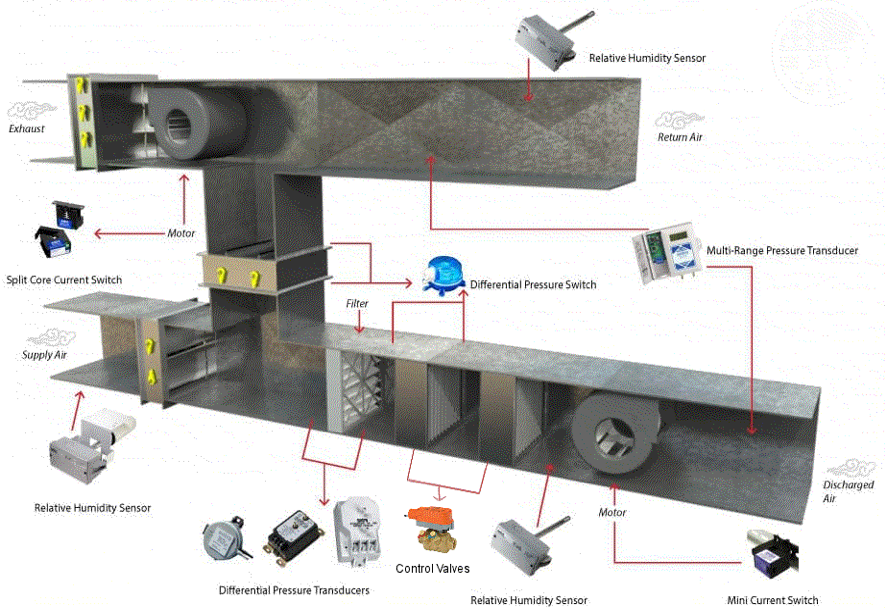
The heat must be efficiently removed from the data center, or the electrical components will malfunction, servers will exceed their specified temperature—and relative humidity—range, and the equipment will go offline. No data center manager wants to receive that alert on his/her mobile device. Fortunately, a variety of cooling strategies are available:

  • Air conditioners and air handlers
    Computer Room Air Conditioner (CRAC) or Computer Room Air Handler (CRAH) units are the most common solution. These blow cold air in a set pats to remove the hot air from the area.
  • Hot aisle/cold aisle
    Cold air is distributed to the front of server racks while hot air out passes from behind the racks. This approach attempts to manage airflow to conserve energy and reduce cooling cost.
  • Hot aisle/cold aisle containment
    This approach separates the cold and hot air in the server room and removes hot air from server cabinets.
  • Liquid cooling
    Liquid cooling systems include air conditioners or refrigerants using cold water near the heat source.
  • Green cooling or free cooling
    Free cooling provides a more sustainable approach to data center cooling, often involving opening a window covered with filters and louvers. The natural cooling approach saves both money and energy.

Build monitoring and maintenance into your project!

Regardless of which cooling approach you take, you must always monitor efficiency and maintain equipment. Be proactive. As you are thinking through your project on the front end, add the essential components to your BOM. These are not overly complex, but they are critical.

Kele offers every product you need to monitor and control temperature, humidity, and pressure, and to manage airflow. We can also provide parts to monitor compressor and chiller run time to track energy consumption. Kele’s project services and technical teams will help you think through your project on the front end and select the right components.

Ultimately, your project is successful in the long term when you avoid downtime, equipment breakdowns, and costly repairs. The right components allow you to monitor and predict when to schedule maintenance to hold the heat at bay. So select your data center cooling strategy and keep it cool with Kele!

Shop kele.com or call us for:

  • Air handler components
  • Actuators
  • Controls
  • Flow switches
  • Moisture detectors
  • Sensors
  • …and more

Call us at 877.826.9045 or email our sales team.

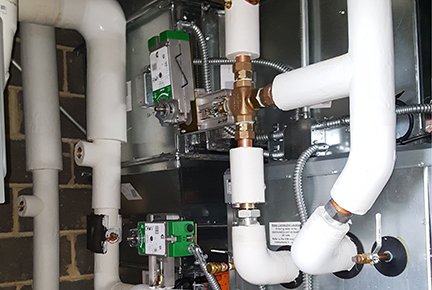
Kele Globe Valves and Actuators Help Run Washington, D.C. Condo AHU

It’s not often that we get to see our products “in action,” so we were excited to receive this image of Kele globe valves and electric actuators from Keith Hickman, Control Division Manager for American Combustion Industries, Inc.

Keith and his team recently installed our products in the air handling unit at The Fountains at Washington House, a retirement condominium community in Washington, D.C.

Kele Fulfills Order to International Space Station

Kele’s mission is to help customers win through an unrivaled customer experience and world-class logistics. An example of this constant commitment is the recent fulfillment of Bacharach 6401-0503 refrigerant leak detectors for the International Space Station.

Years before, a customer purchased refrigerant detectors from Kele, and those parts were installed on board the International Space Station. This year, it came time to replace the original parts. NASA specifically requested that Kele be the resource to fulfill the request. Lucky for NASA, Kele stocks more than 1.8 million parts in our on-site distribution center, and the Bacharach parts they needed were available to be shipped right away!

We can proudly say that we not only offer “world-class” logistics to help our customers win,  but “out-of-this-world” logistics as well!


The Bacharach 6401 Series is capable of detecting the presence of escaping refrigerants. It is model-specific for five different CFC refrigerant types: R-22, R-123, R134A, R-407A. The 6401 Series is designed to be used as part of a control system that helps to prevent the formation of a hazardous environment when properly installed and maintained.

Shop Bacharach 6401 Series.


Backed by more than 50 expert sales associates, and a massive in-house distribution center, Kele stocks 1.8 million parts from 300+ suppliers. We can fill your next “out-of-this-world” order or your entire project BOM.

If you would like to contact us today, please email us or call us at 877.826.9045.

Tennessee State Officials Visit Kele

Kele was honored to host Tennessee Senator Paul Rose and Representative Tom Leatherwood today as part their tour of three Bartlett-area businesses. We were excited to share Kele’s story—our Bartlett roots, current growth, and strategy for the future!

Pictured below are CEO Richard Campbell, Senator Paul Rose, and Representative Tom Leatherwood.

Kele CEO Richard Campbell showing a Kele custom panel are (L-R) Bartlett Area Chamber CEO John Threadgill, Rep. Tom Leatherwood, and Sen. Paul Rose.

Kele CEO Richard Campbell showing a Kele custom panel are (L-R) Bartlett Area Chamber CEO John Threadgill, Rep. Tom Leatherwood, and Sen. Paul Rose.

Kele was honored to host Tennessee Senator Paul Rose and Representative Tom Leatherwood today as part their tour of three Bartlett-area businesses. We were excited to share Kele’s story—our Bartlett roots, current growth, and strategy for the future!

Data Centers: The Need for Speed!

I feel the need—the need for speed!” –Maverick and Goose, Top Gun

Not many of us have what it takes to be a fighter pilot. However, most contractors will attest to two common elements when working on a data center project—job pressure and, above all, the need for speed. While the stakes are not nearly as high as those in a dogfight, the fight to the finish is real. And Kele has been the perfect wingman on countless data center projects.

After all, helping you think through your plan of attack, anticipating project needs, getting your components fast, and providing technical assistance in a pinch is what Kele does best.

Data center construction itself continues to grow at lightning speed and shows no sign of slowing down. As the need for more facilities grows, speed to project execution is front and center and puts significant pressure on the job. It may even feel like “build, fit, design” rather than “design, fit, build.” Fortunately, there are smart ways to maneuver and accomplish your mission on time. 

Plan…but plan quickly.

Think through what you need, how it should all come together, and the potential functionality desired. Often the desired components are not overly complex—sensors, actuators, flow switches, air handler components, temperature controllers, moisture detectors, etc. However, does the owner want to be able to change server racks often? Should rewiring be minimized—eliminating hanging wires in favor of moving components from panel to panel? Are wireless sensors preferred to detect issues between hot and cold aisles? There are many possibilities. Kele’s project services and technical teams can help you think through this quickly and select the best components.

Standardization

Whether a smaller server room, large single-tenant building, or mega-facility that leases space, the general needs for data centers are consistent. In many ways, the setup of most data centers is similar, and owners often prefer standardization. Your project may call for a large or small panel. You may prefer to select and use your own components. You may “simply” need a quick turnkey system, in which case Kele’s Instapanel could be appropriate. However that standardization is defined, Kele’s panel shop can help you build the right solution and repeat it fast and efficiently.

Product availability and logistics

Nothing can be delivered with speed if it’s not available. Find a partner who can deliver. Kele’s inventory of 1.8 million parts in stock from 300+ suppliers is on standby. We have what you need and offer same-day shipping from our distribution center.

The next time you’re feeling the pressure of a data center project—and have the need for speed—call Kele. We can be your wingman anytime.

TECH TALK: Lighten Up—Tips for Changing Outdoor Lights with Changing Seasons

We have a customer whose parking lot lights are controlled by the building automation system using input from a light sensor. With the arrival of spring and daylight-saving time, he has noticed that his parking lot lights are already on while it is still daylight. Knowing he is wasting money, he asked us to change the threshold so that the lights come on at dusk. Clearly, the light sensor signal threshold that brings on the parking lot lights in the control program needs to be tweaked. What is the best way to go about doing this? Although we live in a high-tech world, some things are best adjusted based on human perception. Whether the customer’s light sensor is a precision unit calibrated in foot-candles or an inexpensive uncalibrated unit, we suggest the following approach:

  • Schedule a meeting with the building owner at the building shortly before dusk to select the light level when he prefers the parking lot lights turn on. If he defers to you, use your “engineering judgment.”
  • Prior to the meeting, study the BAS control program to locate the place where the light sensor signal is checked against a threshold value to determine when to turn on the lights.
  • Determine which controller AI input is receiving the light sensor signal and be sure you know how to read the light sensor AI input value on the BAS system screen.
  • Meet again with the building owner shortly before dusk. Ask him to watch the parking lot and tell you when he wants the lights to come on. When he gives the OK, read the light sensor value on the controller AI input. Modify the control program to use this new value for the light turn-on threshold.

Using this approach, the actual precision of the light sensor is unimportant. The only important thing is that the signal value is repeatable for a given light level. You might find that a different threshold is needed in the morning for light turn-off. If that is the case, repeat the above procedure at dawn and, if necessary, modify your control program to use the two different thresholds depending on whether it is dawn turn-off or dusk turn-on. If the light level sensor ever needs to be replaced and it is a precision unit (calibrated in foot-candles from the factory), you should not need to change the thresholds in the control program. However, if you are using an inexpensive uncalibrated sensor, such as the Kele PSR-1, swapping the sensor will require a recalibration using the above procedure.

Rich Schnarr Becomes MIControls President and General Manager

Kele, Inc. announced today that Rick Schnarr has joined MIControls, Inc. as president and general manager. The move became effective on Jan. 1. Kele acquired MIControls last June to expand its presence in the western part of the country. Schnarr, an industry veteran with nearly 40 years’ experience, will lead that effort moving forward.

“Rick’s addition is another step in support of Kele’s next-level growth strategy and mission to help our customers win,” said Kele President and CEO Richard Campbell. “His background, expertise, and customer relationships developed over four decades will only accelerate our success in the region.”

Steve Roe will become president emeritus following nearly 46 years with MIControls and the companies that preceded it. Roe became president and majority owner of MIControls in 2007.

“Steve has been a true partner during Kele’s acquisition of MIControls and over the past six months,” said Campbell. “He will play a vital role in this transition.”

Schnarr’s career includes a variety of customer-facing, sales management, and general management roles. Most recently, he was vice president of sales and marketing for Johnson Controls’ Commercial and Applied Ducted Systems organization. Over the years, Schnarr served as president of Johnson Air Products in Portland, Ore., general sales manager of Trane’s Honolulu office, and in branch management with Carrier.

“I am extremely excited about leading MIControls and becoming part of the Kele senior leadership team,” said Schnarr. “I’m looking forward to leveraging the strong reputation of MIControls in the Seattle and Portland markets and supporting our team as we transition to meet future goals. We want to be the best solution for our customers in every facet of the business.”

Schnarr is a US Navy veteran, serving with the submarine force and earning an expeditionary medal and two Navy Commendation Medals for outstanding service as a ship diver and diving officer at sea.


Candid Conversations with Kele Suppliers: Dwyer Instruments

Supplier partner Dwyer Instruments visited Kele earlier this month. Dwyer President Mark Fisher chatted with Kele CEO Richard Campbell about few key topics that will interest Kele customers. Watch this brief video and hear the latest on the Kele-Dwyer partnership, solutions for tariffed products, and Dwyer’s new Series IEF Insertion Electgromagnetic Flow Transmitter.

Listen to Dwyer President Mark Fisher discuss updates with Kele CEO Richard Campbell.

  • Kele is in the process of expanding its inventory of Dwyer SKUs to around 2,500 SKUs.
  • Kele has responded to tariffs with a product matching solution on kele.com, complete with direct and functional product alternatives. Dwyer is elevating solutions with no tariffs.
  • Kele recently added Dwyer’s new IEF Insertion Electromagnetic Flow Transmitter, a field-programmable flowmeter specifically designed to offer superior performance paired with simple installation and use.
    • Long life cycle
    • +/- 1% accuracy
    • Adjustable unit fits pipe sizes from 4” to 36”
    • Optional LCD display
    • BACnet and Modbus communication in addition to the standard analog, frequency, and alarm outputs
    • Performance unaffected by temperature, density, or viscosity

Stay tuned for Kele’s next Candid Conversation!