Kele Blog

Making Your Job Easier (and Mine too)

My first exposure to power monitoring was the WT series. I started out in the warehouse shipping them. Then I progressed to stripping the wires used for the CT shorting assembly. After that I assembled them, put them in enclosures, and added the shorting switches when they were ordered. From the warehouse I moved to the sales department where I got to enter orders for WTs. Finally, I moved to tech support where I got to recommend, sell, and troubleshoot WTs. I am not ashamed to say that it was one of the most difficult challenges. Power monitoring, the WT in particular, made me cringe. High voltage/high current electricity is dangerous. While the WT was a fine product; it was very hard to troubleshoot – especially over the phone.

Then Kele had a significant breakthrough: The PT-9000 Series PowerTrak Monitoring Interface. Even the name is cool. It had 9000 in the series name long before Internet memes taught us that 9000 = cool. The PT-9000 went way beyond the WT. It was like adding indoor plumbing. The PT-9000 has 2 configurable 4-20 mA outputs and a pulse output for kWh. It also has lights, wonderful lights that tell the full story of how the unit wired – a gift to the telephone trouble shooter. To top it off it has an auto configure feature that corrected CT/phase wiring errors. Not long after the launch came the communication abilities (BACnet, LON, N2, Modbus) that made the user capable of capturing parameters never dreamed of by the WT.

And now we have the endicator™ Intelligent Power Monitor with its 58 monitored parameters, easy to use interface, installer focused design, standard NEMA 4X enclosure, I could go on for quite a while with this. I’ve only played with the beta but I’m pretty sure it can change Coke to Pepsi and find your car keys. It’s that cool. All kidding aside the endicator™ launch is very exciting for me. It truly is the evolution of power monitoring.

The WT series is still alive and working in many installations around the world and we still get the occasional tech call about them and they still scare me a little, but that doesn’t stop me from helping when I get those calls. Truth be told the WT did make me a better tech support person, kind of like the fat football coach that always made you run, called you horrible names, and yelled at you all the time. Sure you hated him, but he made you better.

The Dark Arts

Sometime last week I answered the phone in my usual manor when the man on the other end asked simply “tech support?”

 To which I replied, “Yes, this is tech support”.

“I need someone that knows the ‘dark arts’” he said.

“I don’t know who you are.  I don’t know what you want.” I told him.  “If you are looking for ransom, I can tell you I don’t have any money.  But what I do have are a very particular set of skills, skills I have acquired over a very long career.  Skills that make me…”

OK – I didn’t really say that.  You caught me.

When the customer asked for someone that knows the “dark arts” (that part is true) I did ask him if he was talking about pneumatics, which he was.  Pneumatics, the dark arts of the control world, I wish I had thought of that.

Truth be told, there is nothing “dark” about pneumatics.  Pneumatic systems, when properly installed and maintained, have always been highly efficient and had the ability to provide excellent control.  It should also be noted that pneumatics are not dead.

Many Kele vendors, including Schneider Electric, Johnson Controls, and Honeywell still providea full line of pneumatic parts.  We even have a section of our catalog dedicated to pneumatics and, more importantly, we have people here at Kele that are here to help you with your pneumatic applications.  There is no need to fear the “dark art” known as pneumatics, just call Kele.

Get Ahead of the Curve

Understanding and then selecting the right temperature curve might seem like a daunting task. To a newbie, it might seem impossible but there is a logical, systematic method to selecting the right temperature sensor.


Basically, the thermistors we use in our systems have negative temperature coefficients meaning as the temperature rises, the corresponding resistance decreases; but, the relationship is far from linear.


We refer to thermistors by their resistance value at a specific base temperature, usually 77°F (25°C), and a “Type” number that designates the specific relationship of resistance to temperature throughout the relevant range.


This relationship depends upon the mix of materials from which the thermistor is made, and for simplicity’s sake, each recipe is assigned a different designation. These are listed in product specifications, ordering information, and the Technical Reference sections in both your Kele catalog and the technical reference section of Kele.com.  To make it easy, you can also click here..


For example, the Precon ST-S3E Executive wall sensor uses a high-quality Precon Model 3 thermistor. This sensor has a resistance value of 10 kΩ at 77°F (25°C), and varies according to the Type III temperature/resistance curve.


The important take-away from this is to make sure that both the base resistance and the type designation for a thermistor sensor match up with the BAS to which they’re connected.


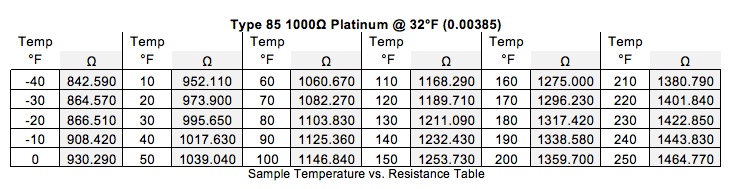
RTD sensors have positive temperature coefficients, meaning as the temperature rises, so does the resistance value of the sensor. Like thermistors, RTDs are classified by a base resistance value, but at a different base temperature, 0°C (32°F). RTDs behave in much more proportional way than thermistors as the change resistance.


Each controller is designed and manufactured to use a specific temperature curve. Using the wrong curve will lead to poor control due to inaccurate temperature sensing. Easier still, call Kele and ask for Technical Sales. We’ll help you pick the sensor that’s right for your application!

Make Your Job Easier with Kele’s Sensor Tips

Every decent-sized Building Automation contractor should have a sensor whisperer; the guy who knows instinctively exactly where each sensor should go…even when there’s no plan. If your company doesn’t have a sensor whisperer, we can help. Our technical support staff can always help you with just the right touch for perfect sensor installation guidance.

But for the rest of us sensor newbies, we offer these 6 obvious and not-so obvious tips for spotting and installing wall-mount temperature or humidity sensors:

  1. The most obvious factor of all is to confirm that the sensor location is in the space served by the air handler (or other terminal unit) with which it is associated. If the ceiling is in place, it’s best to at least have a chat with the folks who installed the sheet metal – make sure nobody decided to do some re-zoning without informing you.
  2. Treat sensors like vampires, avoid sunlight. In fact, it’s better to stay at least several feet away from any portion of wall that gets direct sunlight. Surface temperatures of sunlit walls can be as much as 20°F (11°C) higher than room air, and this heat can be conducted to a nearby sensor.
  3.  Avoid outside walls, unless the only other choice involves direct sunshine.
  4.  Avoid other sources of heat within the space. If not yet occupied, ask where electrical equipment will be placed. A temperature sensor on a wall above a copy machine can make a room mighty cold. If sensing humidity, an elevated temperature at the sensor location will cause it to report lower values than a sensor at actual room temperature.
  5. Avoid the supply air stream. Sometimes this can be a challenge. Even if the room’s supply air diffuser is a good distance away from the wall, its output may travel across the ceiling and down the wall, causing false readings at the sensor. If a diffuser cannot be avoided, line up the sensor with the corners of diffusers. If all else fails it might be time to get creative. We’ve seen cases in which shelves had to be built to shield a sensor from direct blasts of supply air.
  6. Avoid leaks. Even in interior rooms, the air from the space within the wall can be warmer or cooler than the conditioned area. In some cases, the moisture content can be very different, too. Seal the holes, including the hole for the sensor cable.

These 6 tips are what all sensor whispers know instinctively, for the rest of us, there’s Kele. We can help with your sensor installation. Remember, at Kele we have more than 100 combined years of technical expertise in Building Automation and some of us might even have…the gift.

Need Help Retrofitting Pneumatics to Electric Actuators?

In the current economic times it can be difficult to convince a client that it is necessary to remove a working valve just to change out the pneumatic actuator controlling it.  Re-piping and draining the system alone means down time and extra labor that probably isn’t in the budget.  The obvious solution is to leave that valve there and upgrade the actuator.

There are companies out there, like Belimo, which have an entire section of business dedicated to retrofitting other company’s old valves though there are limitations to this. They mainly focus on the most common valve lines for the major valve manufactures.

Here at Kele we work daily with many of the manufactures that have been making valves that are still working away after 30 years of service.  All it takes is a valve body model number and we can do the rest. Though sometimes the valves are just too old and the designs have changed so much that there is no way to mount a modern actuator on it; more often than not we can offer an option.

If you have a situation where you want to try to retrofit but don’t know where to begin, start by getting as much info from the parts on sight as possible.  First is the valve number, which is hopefully on the tag that no one has torn off in thirty years.  If there is no tag (very common) write down all of the markings on the body itself and if possible take a picture.  While you at it take down all of the info off of the actuator as well.

It is important to note that it is never possible to choose a new actuator for a valve based on the old actuator number when going from pneumatic to electronic.  This can only be done with the valve number.  The info on the actuator is helpful however, and can give up clues to things like normally open or normally closed.  Plus if an old valve with no tag has an old Barber Colman actuator on it that will at least point us in the right direction.

As you can probably tell, this really isn’t an exact science but it is a viable option.  We are always happy to try, especially if it means saving you time and money.  So, next time you are staring at an ancient valve and don’t know where to start, give us a call.

Kele Pieces Together the Component Hospital

One of the great perks of working for the nation’s leading supplier of building automation products is field trips to locations where there are interesting applications for our products.

Case in point, I drove to Joplin on February 21st in my quest to learn more about Joplin’s “component” hospital. If you remember, Kele was Xcel Mechanicals supplier for custom ACI Temperature/Humidity sensorsUATsPower SuppliesRPS and SRPM monitors for the job.

When I arrived I was greeted by David and the Xcel Mechanical foreman for the job, Sean Brown.

We discussed unusual aspects of the job and the challenges.  While expense is always a concern, it was more so here because the hospital structure was temporary. Consequently, not many digitally controlled systems (DDC controls) were specified for the job.  The primary objective was environmental comfort for the patients and staff.

I was glad to hear their raves about Kele. While the project had its challenges, Kele was doing everything possible to make it easier. David was very appreciative of Kele and Jon Butler, saying that Jon was always on top of orders and the communication was great.  He liked the fact that we had the products in stock and could ship when needed.

After the introductions and the overview, it was time to get to the actual site, something I’d been itching to do. From the outside the hospital looked like one of the many construction sites I have been to in the past.

Once David and I entered the structure, the differences stood out.  I could see the unfinished areas where the modules were pieced together like building blocks.  Many of the junctions where plumbing and electrical were connected were between sections.

David explained that a lot of the work was completed before the modules were shipped to the site.  Plumbing systems and tiling finishes were actually installed at the factory.  It was amazing.

David showed me where Xcel Mechanical installed the ACI temperature/humidity sensors and the Setra room pressure monitors they had purchased from Kele.  David and his team do good work.

To give you a better idea, here are some photos.

Our conversation continued and David brought up our new power-monitoring product endicator. Then we talked about EnOcean and the way energy harvesting worked.  David and Sean seemed very interested.  While it may not have applications for this temporary hospital, it may be a smart addition to the future one.

Driving to the Mercy Hospital job site, we drove where the tornado had been, and it really hit me how devastating this storm must have been.  There was a huge barren swathe through town where homes and buildings were once standing.  You could see new house being built and the town recovering but it really caught me off guard.  Look at Joplin, Missouri, on Google Earth, and you can see where the storm had been.

Winding down my visit, I asked what they were going to do with the temporary hospital once the permanent one was completed?  David told me that they would repurpose the components. They would ship modules to other hospitals that needed them.  Say, a hospital in Florida needed an Operating Room. They would package it up and ship it down.

Talk about recycling!

Kele Belimo ActuatorBelimo Actuator

Setra Room PressureSetra Room Pressure

Beginnings of a Modular HospitalBeginnings of a Modular Hospital

Module Being Lifted into PlaceModule Being Lifted into Place

All Modules in PlaceAll Modules in Place

View from the TopView from the Top

Kele Hits the Road to Investigate Component Hospital

Well, when it comes to intriguing new applications for Kele’s peripherals in building automation systems, I just can’t help being nosey.

A couple of weeks ago I received an email from one of our account executives, Jon Butler, about one of his customers who was working on temporary hospital in Joplin, Missouri.

Kele was the Xcel Mechanicals supplier for custom ACI Temp/Humidity sensorsUATs, PowerSuppliesRPS andSRPM monitors for the job.

If you remember, Joplin was the town that was hit with a huge tornado on May 22, 2011.  The RF-4 (second strongest) tornado was the most deadly in 60 years.   It cut a path of destruction six miles wide. The hospital was among the buildings destroyed.

The new hospital, slated for completion in early 2015, will be built with 327 inpatient beds to support the region with a planned expansion of up to 424 beds. The plans include beds for medical/surgical care, critical care, women’s/children’s services (labor, delivery, recovery and postpartum rooms), behavioral health and rehabilitation.

In the interim, Mercy Hospital has been delivering care from a mobile hospital.  To bridge the community’s healthcare needs between now and 2015 when the new hospital is finished, Mercy is constructing a “component” hospital that will serve until the main project is completed. Like pre-fabricated housing, a component hospital is made up of modules that are built off site and then delivered to the site where they are joined together.

Well, I’d never seen a component hospital under construction, and I was due for a road trip, so I asked Jon Butler to help me get in touch with David Brown, Superintendent from Xcel Mechanical who was working on all the mechanical,  and building automation for the component hospital.

David was more than happy to accommodate my curiosity. Stay tuned and you’ll hear more about this exciting trip. And just to pique you interest I’ll share with you these great photos…

High SchoolHigh School

Now a Vacant LotNow a Vacant Lot

Much Anticipated WebStat Controller and Thermostats Now Available

We’re always adding new products to our lineup here at Kele. As the leading supplier of building automation products, we have partnership with more than 300 great manufacturers worldwide.  And, our newest catalog has added over 130 product groups and is more than 12000 pages. If you don’t have a copy, you can request a copy online.

Few new products, however, are generating as much excitement as the Honeywell WebStat Controller and T7350H Thermostats and Sensors we’ve just added to our inventory.

In my opinion, this is a game changer for HVAC and Building Automation companies looking to source this popular web-enabled controller that allows the system manager to monitor and control up to 20 thermostats and sensors using the internet.

Our customers have been asking for a solution like this for years. We’re delighted that Kele can sell these products and ship anywhere in the U.S. Now our customers can buy the WebStat and compatible thermostats and sensors from us, and get Kele’s same-day shipping and legendary technical support.

We sold one of these controllers the first day it was available and we hadn’t even launched it yet. Some of my colleagues have asked me why the customer demand for WebStat and its communicating thermostats and sensors is so great.

I tell them WebStat provides a way for our customers to step up from standalone thermostat control to web-enabled monitoring and control of multiple thermostats without incurring any excessive cost or complexity. Wireless device options and automation features, such as alarming, trending, scheduling and network accessibility, combine to deliver significant operational savings through remote monitoring, alarming, floor plan visuals and user privileges.

User friendliness is also a big plus for WebStat installers and users. It makes remote control simple and convenient by allowing Internet accessibility and flexibility for assigning user privileges. A single WebStat system can support up to 20 T7350H thermostats and sensors, so it offers ideal control for a wide range of building types and styles.

Because WebStat lets you track everything from temperature and humidity, to discharge air temperature and outdoor air temperature, users can remotely troubleshoot and monitor their entire system. They can preset alarms to notify designated people in the event of an unwanted change, helping to catch problems early and reduce downtime.

While many thermostats limit programming to a 7-day schedule, this system offers 365-day programming allowing users to easily maximize energy savings. Programming can mirror the building’s occupancy schedule without requiring special changes for holidays and events. The user can create up to 10 unique schedules to meet a variety of scheduling needs.

Many customers see the extra value in purchasing Honeywell WebStat and T7350H Thermostats and Sensors through Kele because they know Kele will have it in stock, ship it the same day and bundle it into a single invoice with any other purchases from the other more than 300 manufacturers’ available through Kele. Plus, Kele’s seasoned techs are always just a phone call away.

No Silver Bullet for Rising Energy Costs, But There is Power Monitoring

You may have noticed that energy prices are on the rise.

While there is much chatter about wind farms, solar panels and hydrogen-powered vehicles, Building Automation Industry customers are reliant upon current energy sources and those prices continue to go up.

While we have little control over energy prices, we can control costs by controlling energy consumption.

Our government has also recognized the need to curb energy consumption with legislation like the “Energy Independence and Security Act of 2007

In addition to legislation, ASHRAE has updated its standard 90.1 -2010, the Energy Standard for Buildings (except Low-Rise Residential Buildings).

Many states refer to this standard when drafting codes and regulations regarding energy design and implementation for new construction or major renovation projects.

I think we can all agree that this is valuable information that can help us save energy and save money.

But, the first step in saving energy is to identify where you’re using energy and exactly how much.

That’s why power monitoring is critical. Power monitor devices let you know exactly how much energy you are using and when. That knowledge can help you determine equipment and process changes what will reduce energy consumption and costs.

The good news is that Kele, the nation’s leading supplier of building automation products, has a new power monitor on the horizon that is going to help to make this process easier than ever before.

In the next few months we will be releasing information on our new Kele power monitor, endicator™. We’ll also give you great tips on submetering, smart metering and remote power monitoring, and how it can help you in your energy conservation efforts. For a sneak peak, check out the product page.

So, stay plugged in.

Kele Customers Tell Us Why They Buy From Us!

It’s hard to be humble.

While the Las Vegas AHR show is behind us, hearing what you had to say about Kele lives on! Several of our customers told us specifically what you thought about Kele. A short video below demonstrates a few of the highlights.

When we asked the question “Why do you buy from Kele” this is what our customers had to say:

Kevin Studebaker, Sr., Studebaker Control Solutions: “Having the parts, having them in stock, being able to get them out quick, and then we in turn can get it to our customers quick.

David Handwork, Arkansas State University: What’s really kept us with Kele is their customer service.”

Gerald Jannicelli, Technical Building Services: “They have a great catalog, their selection is easy, we always know the price and the product gets shipped out quickly so we can take care of our customers.”

Ed Ransom, Open Control Systems: They’ve got a great selection, great prices, great people. If you’ve got a problem, they take care of it. If you’ve got a building automation need, you’ve got to call Kele.

Kristen Smith, WayPoint Systems: “I buy from Kele because the catalogs are easy to use, the website is easy to use. I always have updated pricing. They make my job easier.”

We can talk about how Kele associates thrive on helping find the answers you need to technical questions, applications issues, or just plain product information or how Kele takes pride in getting our customers the right products when you need them — but I think the video comments say it best!

Take a look at the video and you’ll know why we say it’s hard to be humble. We’d love to hear why you buy from Kele and any suggestions about how we can make your job easier. Please leave your comments below.