Sponsored by Honeywell
The steps and considerations for selecting a Variable Frequency Drive (VFD) are mostly straightforward. In fact, the nameplate on the motor usually provides the essential information, such as voltage and horsepower. Once you determine whether it will be installed indoors or outdoors, and if it needs communication, you’re almost done!
The final question is often the most misunderstood: Is a bypass needed? Why or why not? Let’s look at when you should include a bypass and the different types of bypasses available.
Kele offers five configuration options of the Honeywell Smart VFD.
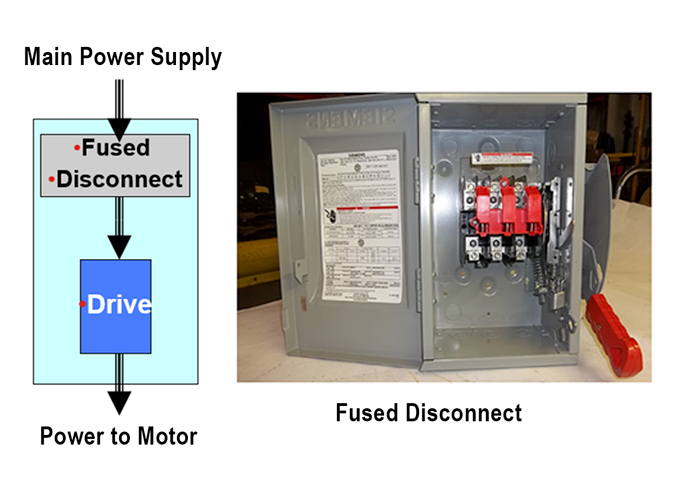
Option 1 is the drive only without any disconnect or bypass. The most common is Option 2, which includes a fused disconnect. These disconnects are required by most electrical codes and a good idea in general. If your electrician does not add a disconnect during installation, you can order one with your new drive.
Option 3 is a 2-contactor bypass, and Option 4 is a 3-contactor bypass. Both are designed to minimize system downtime should the VFD fail. These bypasses are ideal for facilities that run 24/7 and can neither afford downtime nor wait for after-hours repairs, such as a big-box store or casino. The difference between the two centers on how easily the failed drive can be replaced. If a VFD fails, the motor it controls will stop running completely.
A 2-contactor bypass allows a technician to flip the switch, bypass the VFD, and the motor will resume running at 100 percent speed. Eventually, the systems should be shut down in order to safely replace the drive.
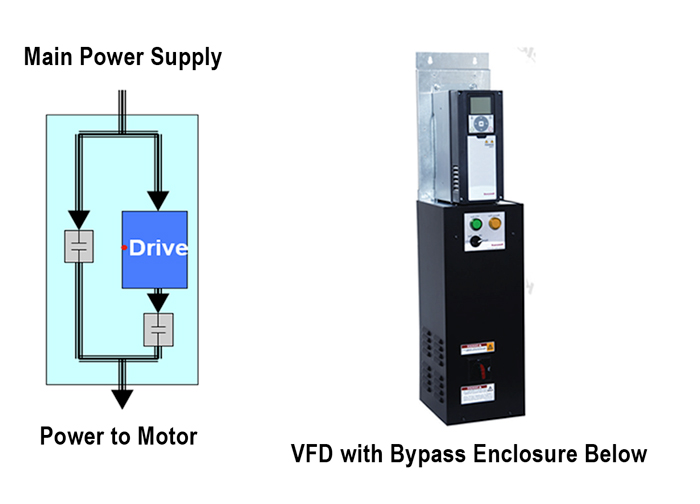
A 3-contactor bypass adds another contact before the drive that removes power going to the VFD when placed in bypass mode. This means that if the VFD fails, it will be bypassed to maintain motor operation, and the VFD can also be safely removed and replaced with a new unit without interruption in motor operation. This is the main difference between a 2- and 3-contactor bypass:
- With a 2-contactor bypass, you must kill the power before changing the VFD.
- A 3-contactor bypass allows the VFD to be changed while in bypass mode with the motor running.
The final option to consider when selecting a VFD is a 3-contactor bypass with auto changeover. This is typically used only in mission critical spaces that are constantly occupied and cannot tolerate downtime. A hospital operating room is a perfect example. The built-in fault contact on the VFD is monitored by the bypass and automatically bypasses the drive if it begins to have problems. This basically eliminates any loss of service while the VFD is being repaired or replaced. This option is rarely needed in a typical HVAC application.
As you may have guessed, bypasses are complex and can add substantial cost to an already higher-cost device. Typically, a bypass is only added at the request of the customer or if required by a spec. In most cases, a simple fused disconnect provides plenty of protection.
Call Kele with your specific VFD needs, and we will find the right drive for you!

 MEMPHIS, Tenn. – Kele, Inc. announced today that Danny Lyons has joined the company as Chief Financial Officer. Lyons previously served as Kele’s corporate controller for three years between 2014 and 2017. Prior to being named Kele CFO, Lyons spent one year as director of financial reporting and controls with VIP Cinema Seating in New Albany, Miss.