Kele Blog

The Importance of Negative Pressure in Healthcare

While medical staff is working non-stop to clear infections from patients, medical facilities’ HVAC systems are working non-stop to keep the air clean and contaminant free. Negative pressure in a medical facility, such as a hospital, is a must-have to prevent infection from spreading from one area to another, which will help prevent infection spreading from person to person while in said facility.

Negative pressure rooms are common in the fight against infection control. The science behind these rooms is that lower air pressure allows outside air into a controlled space. It holds the infected air particles and doesn’t allow them to escape from the room. Most hospitals utilize these solutions to keep negative pressure rooms up to standards:

  • Sealed floors, walls, windows, and ceilings
  • Entryways with self-closing technology that have adequate seals
  • HEPA filters to contain and control airborne contaminants
  • The correct ductwork, fans, and dampers to move air out of the building
  • Air pressure control and monitoring systems
  • Supply and exhaust rates

Hospitals use these solutions and more to keep infectious germs from running rampant throughout a hospital or healthcare facility. Most hospitals designate the following as negative pressure areas:

  • Bathrooms
  • Airborne Infection Isolation Rooms (AIIRs)
  • Triage areas (to include waiting rooms as well)
  • Decontamination rooms
  • Darkrooms
  • Autopsy

While this is not a complete list of negative pressure areas and rooms, loss of negative pressure in any of these places could be catastrophic. Not only would odors begin to trickle through the facility, but the spread of airborne contaminants would be unstoppable. Without HVAC systems in place that are up to date with OSHA and ASHRAE guidelines, patients, visitors, and staff would be exposed to any number of pathogens.

Monitoring and controlling room pressure are critical. Kele carries a variety of room pressure monitors and pressure accessories from trusted suppliers. The Kele team can help you find anything you need, and our tech service staff can help troubleshoot any issues in the field.

Shop Kele pressure products here.

Question from the Field: What Key Components Do I Need for an Isolation Room?

We have received numerous questions over the past few weeks about key components for an isolation room. This comes as no surprise since the world is currently battling the COVID-19 pandemic, which puts HVAC contractors close to the front line. Contractors are needed to help lead the charge in keeping hospitals safely up and running. This includes potentially converting unused dormitories and hotels into emergency hospitals for the overflow of patients that continues to grow every day.

The Centers for Disease Control recommends hospitals “prioritize AIIRs for patients undergoing aerosol-generating procedures.” AIIRs are, of course, Airborne Infection Isolation Rooms. The primary task for engineers and contractors is to create a negative pressure environment. (In the case of a converted space, there may be obstacles from the need to replace HVAC units entirely if they are not up to the task of maintaining safe ventilation.)

Negative pressure is required in isolation rooms because it prevents infected airborne particles from traveling outside the room. COVID-19 spreads through respiratory droplets. In this case, when doors to the isolation room are opened, the droplets will not spread beyond the room.

So, what components do you need? Room pressure will need to be monitored at all times.

  • Room pressure monitorsKele carries a variety of room pressure monitors from Setra, Johnson Controls, and Kele-branded.
  • Pressure accessories – These may include pressure ports, probes, surge dampeners and more.
  • Differential pressure transmitters are also worth noting for pressurization of an entire building, wings, and ducts. We wrote about this delicate balance here.

Call, email, or chat with Kele Technical Service if you have more questions about negative pressure and pressure monitoring in isolation rooms or other areas of a healthcare facility. And thank you to our customers and all contractors working to maintain safe treatment environments and keep critical infrastructure viable. Kele is open and here to support you. Stay well!

A Study Guide for Spring School Projects

Just as school project bidding was coming to a close, schools and contractors alike were surprised to discover that retrofitting might be happening sooner rather than later. HVAC retrofitting is common for schools and typically accomplished over summer break. However, due to COVID-19-related closures this year, the task of retrofitting these institutions may be happening now for some contractors.

Please know that Kele is open and has the in-stock inventory you need for these projects, and we ship same day.

We also want to offer some suggestions that will help keep labor costs down and things to consider when approaching three critical areas within the realm of school retrofitting: air quality, ventilation/air handling equipment, and pneumatics. When considering a school retrofit job, here are a few tips for value-engineering approaches that may save schools and contractors time and money:

Air Quality

  • ASHRAE Standard 62 recommends a minimum of 20 CFM per occupant of outside air. If the outside air intake is based on full occupancy, significant energy is wasted on temperature conditioning the extra outside air. ASHRAE 62 now allows the use of CO2 sensors to approximate the occupancy of an area, decreasing the energy load. An outside CO2 reading may be necessary as ventilation should start when the inside is 700ppm above the outside level.
  • Mold is a particular worry for schools because it builds up on coils, in condensate pans, or in walls. All of these should be checked and cleaned periodically. In addition, use a water detector in areas where water collects.

Ventilation and air handling/unitary equipment

  • Inspect and/or install new filters, but also check ductwork for split seams and ineffective or missing insulation. In addition, install a differential pressure gauge or transmitter across filters to help school maintenance know when (or when not) to chance or clean filters.
  • Dampers and linages are often out of adjustment or not working at all. Fix dampers and make a huge difference in comfort and energy savings.
  • Install or verify the occupied/unoccupied control and sequence of operation for all HVAC equipment. Programmable thermostats or time clocks, if applicable, are well worth the money and return a quick payback. Remember, wiring is no problem with wireless controls.

Pneumatics

  • There are many pneumatic controls out there; we know and love them. Check the compressor cycle rate and the filter/dryer assembly. Check for oil or water in the lines. Rebuilding and/or replacing the pneumatic controls is certainly doable, and you can find the parts at Kele if you need them.
  • Encourage conversion to electronic/electric DDC controls if the school needs better/tighter control via the building automation systems or get electric-to-pneumatic (and vice-versa) transducers to tie the pneumatics to the BAS.

Kele can supply key components that contractors need in order to successfully retrofit a school’s HVAC system. Kele is able to streamline the project process and give you the project support you need to get you from start to finish. Especially with the roll out of My Project Portal, getting your BOMs uploaded has never been easier. We want to help you make this early school project season efficient and cost effective.

Give Kele a call at 888.397.5353 or shop on kele.com today!

A Message to Kele Customers about COVID-19

Kele is open for business.

We know and share your concerns about the spread of the COVID-19 virus. Our primary focus is the safety of our employees, customers, and partners. Kele has taken a variety of measures internally to limit potential exposure at our facilities. We are closely monitoring the situation and will follow recommendations from credible authorities.

Kele remains open for business and will continue to serve customers. We have inventory and are shipping on our regular schedule. Should this change or if there is a disruption from any of our national carriers, we will post an update here.

Among other information and protocols, our internal action plan provides direction to our teams for practicing good personal hygiene and sanitizing workspaces frequently. This includes our shipping areas and City Sales counter. The World Health Organization advised that the likelihood of a shipped commercial good being infected or contracting the virus from a package that has been shipped is low. Read more here.

The Kele team is available and here to support you. Our operating hours have not changed (7:00 a.m.-6:00 p.m., Central). If you need to order parts or need help thinking through your job schedule and logistics, there are multiple ways to contact us:

  1. Call 877-826-9045 for Kele customer service (7:00 a.m-6:00 p.m. Central).
  2. Email info@kele.com.
  3. You can order on kele.com 24/7, including My Project Portal for a full project list or BOM.
  4. Live Chat is also available on kele.com during standard business hours.

Customers in the Greater Memphis Area

You have two additional options to ensure social distancing.

  • Curbside service – Please call City Sales at 901-380-4740 (8:00 a.m.-5:00 p.m.) from your vehicle or prior to your visit. We will have your order ready and deliver it curbside.
  • Local delivery – To help you be efficient on your project site, we can arrange delivery of the material you need via courier/local delivery.

VFDs from Kele: Multiple lines, easy access, trusted source.

Recently, Kele introduced Variable Frequency Drives into our inventory. We partnered with some of the best companies to bring our customers the best VDFs the market offers. Through partnership, we’ve built an offering of powerful and reliable products, developed to the highest quality to meet customer’s motor control needs. Let’s take a look at how each VFD can be utilized for you.

Franklin Control Systems’ VFD boasts reduced installation costs and high reliability with comprehensive inputs/outputs for building automation systems. They are smart-start-patented and have superior motor protection along with electronic overload protection including locked rotor, cycle fault, and maximum time to start (due to mid-sized motor or overload). It also has an FLA out-of-calibration indication that ensures the installer sets overload correctly based on calculated motor size. It has two voltage inputs for auto-run and fireman’s override.

Delta’s VFDs have specially equipped HVAC parameters and PID control functions for energy-efficient operation on top of built-in EMC filters for noise suppression. They come with sensor-less vector control (SVC) and simple navigation to make installation easy. It has a 110VAC control transformer, is UL508A rated, and has excellent variable torque control of asynchronous motors.

Honeywell’s VFD is not only sleek, small, and light but is built with a wide array of configurable inputs and outputs. It has hand/off/auto control built into the keypad and has a DC choke for harmonic protection. It has fire safety controls a standard RFI filter and bypass options for safety concerns.

Siemens’ VFD includes not only an intuitive graphic keypad with a multilingual display but also built-in wizards for faster start-up and a built-in plain text help/maintenance manual. It has a programmable fire override mode and is ready to communicate to a building management system. For maintenance purposes it has a motor switch ride through – the motor disconnect switch can be opened and closed without stopping or tripping the drive. It has one common interface throughout all power ranges, two built-in PID controllers, and has energy savings with over 97.5% efficiency.

With smart technology and customizable options, our VFD brands offer seamless integration into your building automation system(s). With the brands now carried by Kele, customers have easy access to multiple lines from a trusted source.

Shop the selections today.

The Kele LDIM2 and Fluorescent Dimming

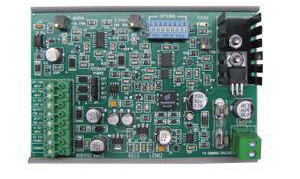
The Kele Model LDIM2 is a dimming control for 0-10V dimmable fluorescent/LED lighting ballasts. It is an excellent interface between a building automation system (BAS) and the dimming ballasts. However, it’s important to understand the workings of the ballast system when designing controls around the LDIM2. The key to understanding this 0-10V ballast dimming system is in the fact that the 0-10V signal originates in the ballast, not in the LDIM2.

The LDIM2 sinks this 0-10V signal and drags it down to the level specified by the input, thus dimming the lights. It also provides feedback on both setpoint and output via 4-20 mA signals. According to the IEC 60929 standard, any output of 10V or above means 100 percent (full) lighting, and any signal of 1V or below signifies minimum lighting for that particular ballast (may be anywhere from OFF to 40 percent light output).

A question we are frequently asked at Kele is, “How many fluorescent or LED ballasts can the LDIM2 support?” The answer is that it depends on the output limits of the particular fluorescent or LED ballasts to be dimmed. Some, for example, comply with IEC Standard 60929 and are limited to 2 mA output on the 0-10V signal. Since the LDIM2’s output is rated at 0.5A, it can drive (0.5A/2mA) or 250 ballasts of this type. Some ballasts are rated a bit higher (non-compliant), and some a bit lower, so it’s important to know the ballast output current limit in order to calculate the number that can be connected to a single LDIM2.

The LDIM2 also features a wide range of input signals: 0-10V, 2-10V, and pulse width modulation from a digital BAS output (adjustable, 0.1 to 25.6 seconds). The dimmable range is typically 40 percent to 100 percent for a typical 0-10V dimmable ballast. In addition to feedback from both setpoint and output, the LDIM2 features manual override settings of 40, 50, 60, 70, 80, 90, and 100 percent. In the event of input signal loss, the output can be set to go to 100 percent level, or to maintain the current brightness level (dip switch selectable).

There are also ballasts (primarily found in theatrical stage lighting) that expect the controller to source the 0-10V signal. These ballasts are specified to conform with standard ESTA E1.3, Entertainment Technology – Lighting Control System– 0-10V Analog Control Protocol. If you run into this type of ballast for fluorescent or LED systems, your controller must source the 0-10V signal, and you’ll still need to obtain the current requirements for the ballasts in question to determine how many you can control with a single 0-10V signal from your BAS.

In either case, the 0-10V signal is most often designated as Class 2, per the National Electrical Code. Thus, it’s important to separate the signal wires from the power wires to the LED or fluorescent fixture. Another important note is that ballast replacement must be made with the same make and model as the ballast to be replaced. Doing this maintains the fixture’s UL listing, and also allows for equal dimming of adjacent fixtures. Different ballasts may have different dimming profiles.

Contact Kele with questions about the LDIM2 and your dimming control needs.

AHR Expo Insider: Event Highlights by Kele’s Eric Melby

By Product Manager Eric Melby

After three full days in sunny Orlando attending the 2020 AHR Expo, the Kele Product Management team, including myself, deplaned on rainy Memphis ground tired, but motivated to start shaping new product strategies for Kele from the knowledge gained at the show. I am excited to share some of my experiences from AHR, highlighting a few key products and impressions.

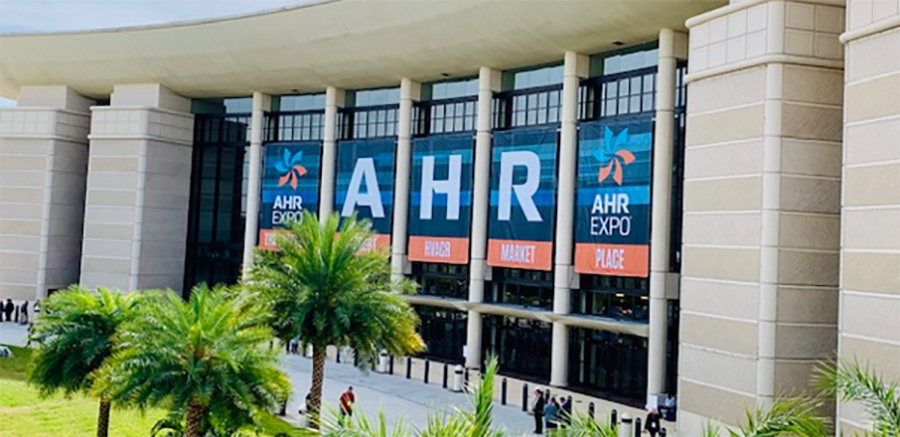
The show was both expansive and impressive. I walked over 15,000 steps per day exploring more than 1,800 exhibitors in a 500K square foot  exhibit space in the Orange County Convention Center. As I ventured through the walkways between booths, I searched for  the “Best of the Best” in new and innovative products. My goal was (and continues to be) enhancing Kele’s product portfolio to better serve and support our valued customers.

With this being my 2nd AHR Expo since I joined Kele, I left with a greater understanding of the wide range of exhibitors that cover all segments of the HVACR industry including residential, commercial, primary HVAC mechanical systems, building automation and controls, and every imaginable ancillary part and service for the entire industry.

The event showcased products from many Building Automation and Controls suppliers and provided the opportunity for several productive meetings with Kele’s key supplier partners.  As expected, many “smart” devices were on display promoting IoT connectivity, including BACnet, EnOcean, WIFI, Bluetooth, Zigbee, Z-Wave and other protocols.  As these technologies are becoming more and more prevalent, a new focus at this year’s AHR show was on network security and the need for BAS designers to address risks and agree on best practices with network use was highlighted.

One of the primary goals of my trip was to identify solutions and suppliers to support Kele’s growing panel business. I was pleased to identify several new product options including DC power supplies, circuit protection, new access hardware, and climate control accessory solutions for enclosures.

Eric Melby speaks with a new supplier prospect for low-voltage electrical components for panels.

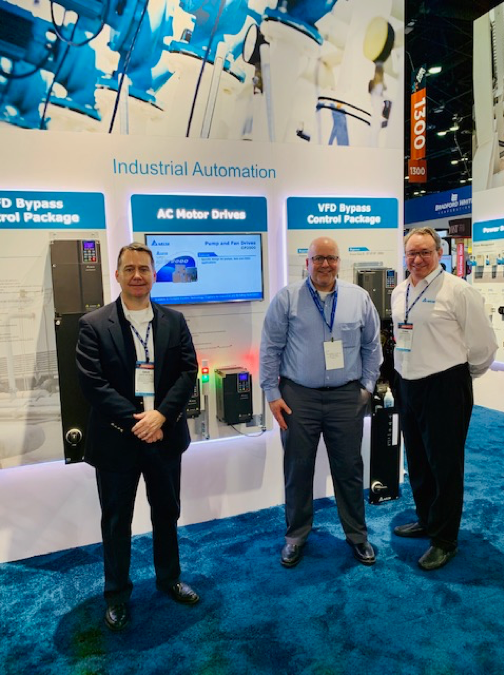
Another highlight was meeting our partner suppliers for Kele’s recently expanded Variable Frequency Drive (VFD) product category. This expansion has given our customers more opportunities to shop VFD solutions from a trusted, reliable source.  In fact, I met with the leadership  team from Delta, one of Kele’s new supplier partners for VFDs to discuss additional product solutions from Delta’s brand. (Here we are after discussing their newly upgraded Bypass Control and Disconnect drive options, which are on display.)

Eric and representatives from Delta discuss Delta’s newly upgraded bypass control and disconnect drive options, which are on display.

Kele, Inc. Wins 2019 ControlTrends Distributor of the Year Award

ORLANDO, Fla. – Kele, Inc. took home Distributor of the Year honors in the 2019 ControlTrends Awards. Kele and other winners were revealed Sunday at the ControlTrends Awards ceremony at the House of Blues in Orlando, Fla. The ceremony coincided with the 2020 AHR Expo, the world’s largest HVACR industry event in Orlando through February 5. Kele was one of seven nominees in the category. This is the company’s first win in the ControlTrends Awards.

“We are humbled to receive this honor,” said Kele CEO Richard Campbell. “It provides us even stronger motivation to continue helping our customers win through simplifying their supply chain.”

Kele marked several highlights in 2019, including greatly expanding its custom panels capacity. The company also launched new technology, notably My Project Portal, an e-tool that allows customers to upload a full bill of material, obtain pricing, and check out within minutes. In July, Kele acquired Temperature Control Systems of Dallas, its third acquisition in less than two years and another step in the company’s growth strategy.

“Getting closer to our customers has allowed us to serve them much faster and across more of their needs,” said Campbell.

Now in their eighth year, the ControlTrends Awards celebrate global companies, products, solutions, technology, and individuals in the controls industry, acknowledging the latest innovations and achievements that make the HVAC, controls, and building automation industries. Kele was also nominated for Peripheral Vendor of the Year and Campbell for both Distributor Executive of the Year and Impact Person of the Year.

Kele CEO Richard Campbell Joins ControlTalk Now to Discuss Kele Growth and eCommerce

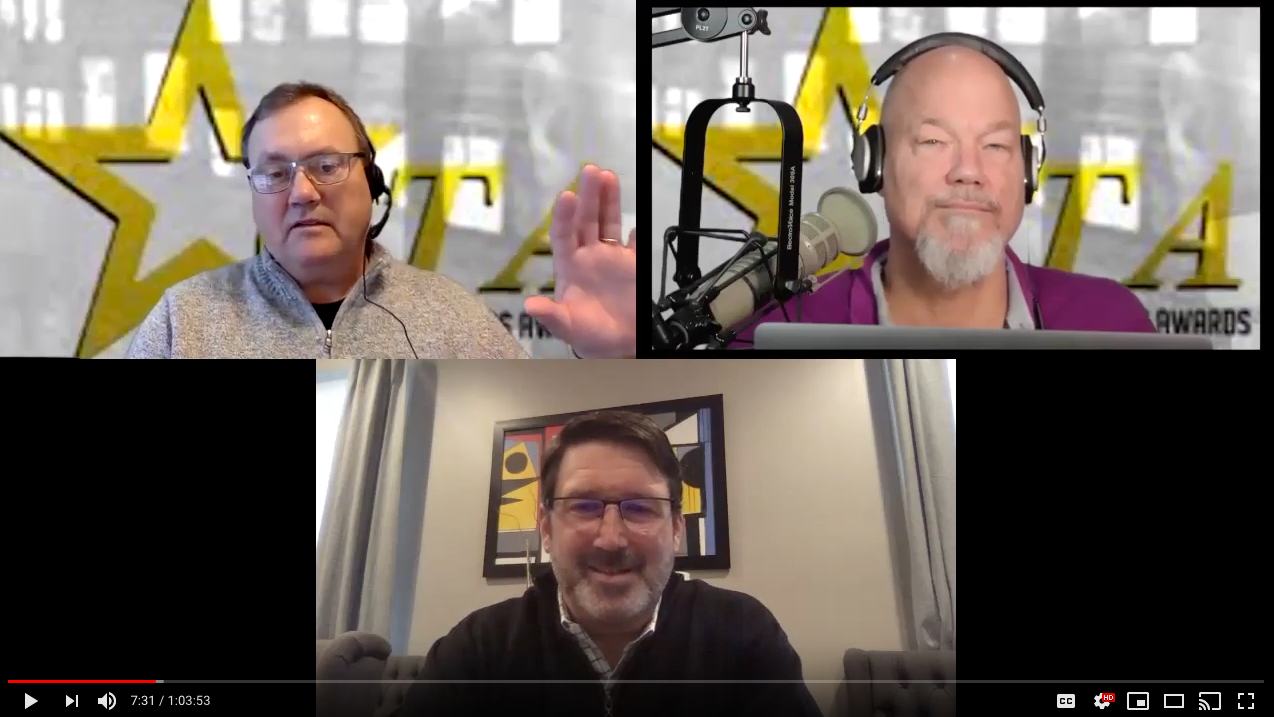
On January 24, Kele CEO Richard Campbell returned to the Control Trends ControlTalk Now videocast as voting for the 2019 ControlTrends neared its deadline. Richard and Kele each received two nominations, including Executive of the Year and Distributor of the Year. Watch as Richard discusses Kele’s growth strategy, culture, integrating multiple acquisitions, eCommerce, and leadership.

Click here to view the entire podcast.

Here is an excerpt from the conversation:

Co-Host Ken Smyers: (Regarding Kele’s mission to simplify the customer’s supply chain and their lives in general.) In our industry, we’re seeing such disruption. While some people aren’t responding very well, you guys are responding enormously well.

Richard: That’s one piece of the puzzle. It’s a multi-faceted puzzle. Getting product to the customer through the cheapest means, which is ground freight, or same-day if we’re in their location. We want to reach everybody within two days max. We’re building out that footprint and getting close, but there are still a lot of areas I’d rather be one day to major metros so we can serve them as they need.

Then there are all the other components—the knowledge, the tech support behind it. The value-add of panel shop, of custom services, of having things show up calibrated and mounted when it hits the job site, so it saves them time.

Then an eCommerce platform that makes it easy for them. We just launched a brand-new program within the Kele eCommerce system called My Project Portal. It’s where a customer can upload their entire bill of material from their estimating system and have it immediately price out, show availability, and with one button you can make that happen.

That’s simplifying it to me.

Click the video link above for more!

Kele’s LDIM2 Sheds Light on 0-10V Dimmable Lighting Fixtures

by Dave Irby
Sr. Technical Sales Support Specialist

The Kele Model LDIM2 is a dimming control for 0-10V dimmable fluorescent or LED dimming lighting ballasts and is an excellent interface between a building automation system (BAS) and the ballast system. While there are several types of light dimming systems available with different control interfaces, customers will find the LDIM2 easy to work with and install, and relevant for a variety of end-use environments. We’ll talk through when, where, and why it is the right choice.

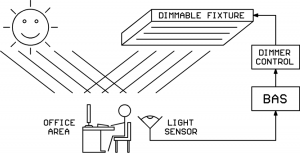
A very popular way to decrease energy usage these days is to use dimmable lighting fixtures and throttle back on the electrical lighting when outdoor light is available, through windows or skylights. A light sensor such as the Kele MK7 family can feed light-level information into a building automation system (BAS). The BAS can then use an intelligent algorithm to vary the electrical lighting level by changing outdoor light levels to maintain a constant level of indoor illumination while saving energy.

In order for the BAS to command the dimmable lighting fixtures to the desired light level, some sort of control interface must exist between the BAS and the light fixtures.

Classic Phase-Chopped High Voltage Light Dimmer System

The first light-dimming system we’ll briefly touch on is the classic phase-chopping system. These dimmers connect in series with the high-voltage line to the lighting load and perform the dimming by removing part of each half-wave of the AC cycle:
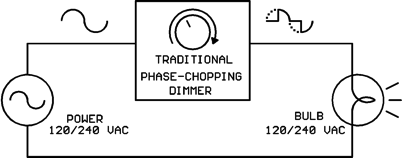
This dimming system is typically limited to small-to-medium incandescent loads although some of the newer CFL and LED light bulbs will work with it also. These dimmers are typically manual-adjust units, without any control interface to a BAS.

Networked Digital Light Dimming Systems

DMX is a networked digital light dimming/control system used in theaters and at rock concerts. DALI is a networked digital light dimming/control system that is popular in Europe and has found some use in the USA.

“0-10V Current-Sinking” Light Dimming System

This is the dimming system we will be discussing today. It is formally defined in the standard IEC 60929 Annex E.

Although the interface is named “0-10V” it’s not like the 0-10V analog interfaces we are accustomed to in the HVAC world! In the HVAC world, the 0-10V is generated in the controller and is consumed by the load like this:
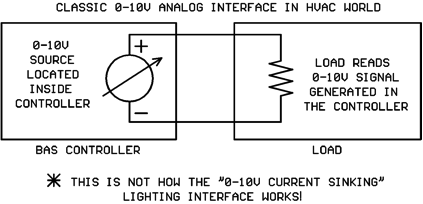
The classic 0-10V analog interface shown above is NOT the same as the 0-10V dimmable lighting interface. The “0-10V Current Sinking” lighting interface is implemented as shown in the following diagram:
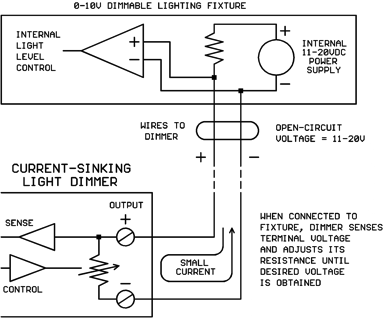
That’s quite a bit different than what we are used to! The voltage source for the 0-10V signal is contained in the lighting fixture, not in the controller.

The voltage source is typically more than 10V, something in the 11-20V range.  A series resistor located inside the lighting fixture allows the light dimmer module to “pull down” the original voltage to the desired value. The dimmer module does this by varying its own internal resistance until the desired voltage appears across its output terminals. Those of you who have studied circuit theory will recognize the combination of light fixture resistance and dimmer module resistance as a classic “voltage divider” circuit.

You will notice that a small current flows around the loop from the light fixture to the dimmer module and back to the fixture. The value of this small current is NOT the control signal, the voltage across the terminals is the control signal. The small loop current is just a necessary evil to make the voltage divider circuit work as needed.

Hmmm… I’m getting the idea that a standard 0-10V output from a BAS controller may NOT work with a 0-10V dimmable lighting fixture.  Is that correct?

That is correct. Your 0-10V BAS output might work with a dimmable lighting fixture if you are very lucky. But probably, it won’t work. If you’re unlucky, you might burn up the 0-10V output on your BAS controller.

So… I need a specialized dimmer control to drive these 0-10V lighting fixtures.  Where can I get such a dimmer control? 

We’re glad you asked. The Kele LDIM2 light dimmer module is specifically designed to interface with 0-10V current-sinking dimmable lighting fixtures. The LDIM2 can accept standard 0-10V 2-10V or pulse-width input signals from your BAS controller and provide the necessary current-sinking 0-10V output for the light fixtures. The 0-10V current-sinking output to the light fixtures is electrically isolated from the BAS signal inputs to prevent any interference between the two systems.

Can one LDIM2 dimmer module control multiple lighting fixtures?

Yes, it can, just wire up the wire pairs from multiple lighting fixtures in parallel like this:
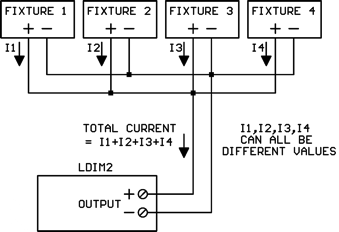
 

The total current flow through the LDIM2 output will be the sum of all the individual lighting fixture currents.  Different makes and models of fixtures may supply different current values.

How many lighting fixtures can I attach to the LDIM2 output?

That depends on the control current flow from each lighting fixture. The maximum load current allowed on the LDIM2 output is 0.5 amps.  So, you can add lighting fixtures until the total from all the fixtures reaches 0.5 amps, but you can’t go further. For example, for each fixture supplied 1 mA of current, you could attach 500 fixtures to one LDIM2 (0.5 amps / 0.001 amps = 500).

If you have so many lighting fixtures that the total control current exceeds 0.5 amps, wire them up in “banks” where each bank is 0.5 amps or less and is controlled by its own LDIM2 dimmer.

How do I find out how much current a particular model lighting fixture puts through the LDIM2?

The IEC 60929 Annex E standard specifies that the control current value should be between 10 uA (microamps) and 2 mA (milliamps). However, there’s absolutely no guarantee that the lighting fixture manufacturer adhered to these guidelines.

If you’re lucky, maybe the lighting fixture data sheet will tell you the value of the control current. If you cannot find a published value for the control current, please don’t just assume a value. Also, don’t mistake the lighting fixture’s supply current for the fixture’s control current. The fixture’s supply current will almost always be on the datasheet, but will be a much higher value, possibly several amps.

If you have access to the physical light fixture(s), you can measure the control current with your DC mA meter. Just put it across the two signal wires coming down from the fixture(s). But beware, the mA meter resistance is less than 1 ohm. It will pull the voltage down very close to zero volts, and the lights will go dark, so don’t do this during work hours in an occupied space unless the people are warned first!

What happens if the fixture wires are connected to the LDIM2 with the polarity reversed?

If the lighting fixture wire polarity is hooked up backward, the voltage will go to about 0.7V which is near 0% light level. Nothing will be damaged, but the lights will go out.

How can I test the LDIM2 on my workbench if I don’t have a dimmable lighting fixture available? 

You can use a standard 24VDC supply and a pull-up resistor like this:
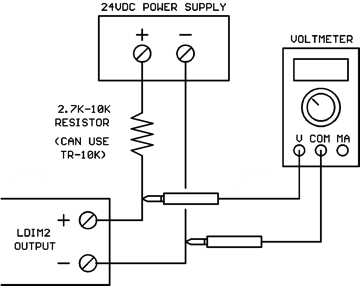
The catalog description of the LDIM2 is “fluorescent dimming control.”  Will it work with dimmable LED lighting fixtures?

Yes, it will work with any dimmable lighting fixture that uses the 0-10V current-sinking interface. You just need to figure out what control current the fixture puts through the LDIM2’s output so you don’t overload it by attaching too many fixtures.

Conclusions

The 0-10V current-sinking interface used by dimmable lighting fixtures is not compatible with the standard 0-10V outputs used in HVAC/BAS systems. You should use a specially designed dimmer control module, such as Kele’s LDIM2, for dimmable lighting fixture applications.

Contact Kele today with light-dimming questions or to discuss the LDIM2.