Kele Blog

Kele Hits the Road to Investigate Component Hospital

Well, when it comes to intriguing new applications for Kele’s peripherals in building automation systems, I just can’t help being nosey.
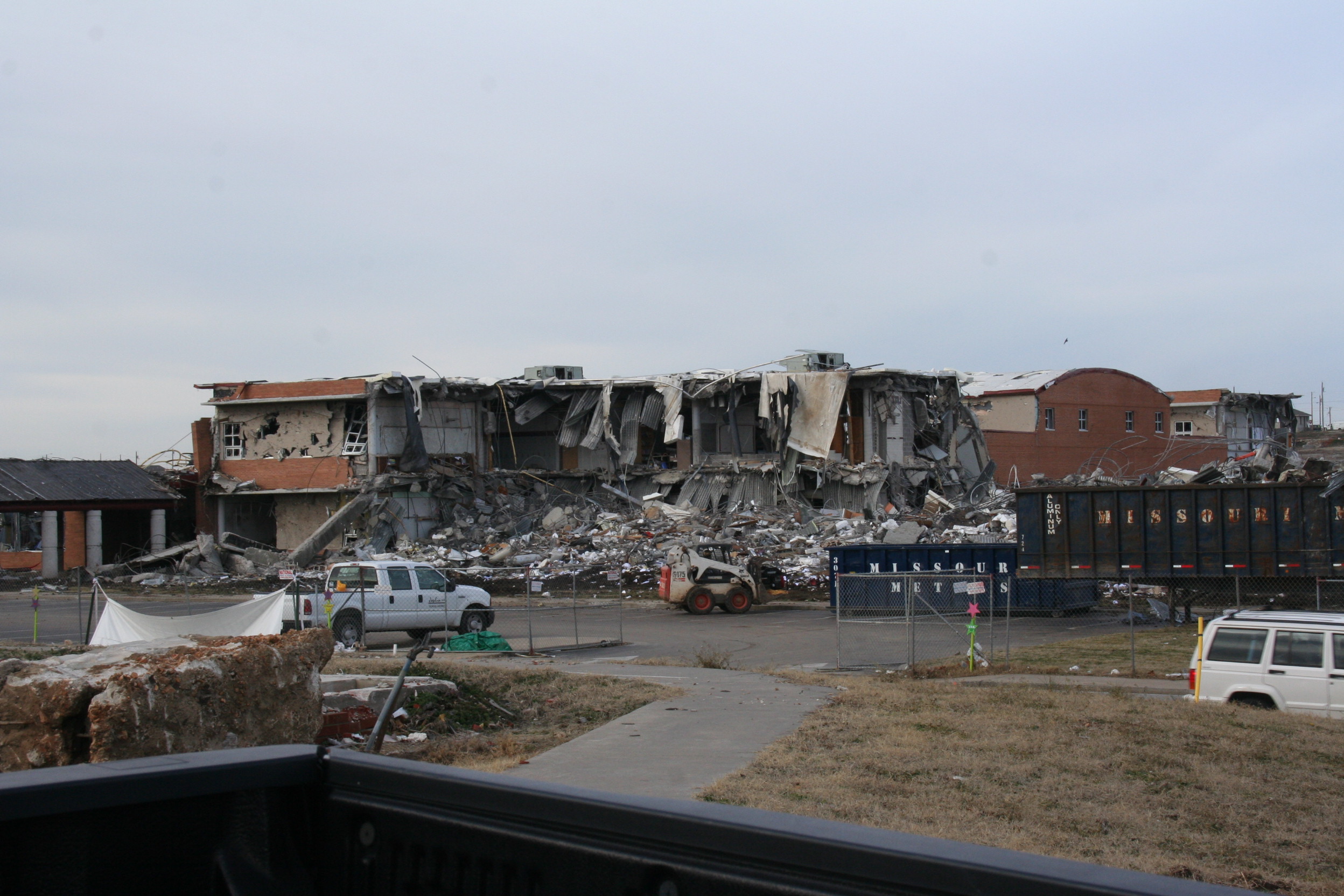
A couple of weeks ago I received an email from one of our account executives, Jon Butler, about one of his customers who was working on temporary hospital in Joplin, Missouri.

Kele was the Xcel Mechanicals supplier for custom ACI Temp/Humidity sensorsUATs, PowerSuppliesRPS andSRPM monitors for the job.

If you remember, Joplin was the town that was hit with a huge tornado on May 22, 2011.  The RF-4 (second strongest) tornado was the most deadly in 60 years.   It cut a path of destruction six miles wide. The hospital was among the buildings destroyed.

The new hospital, slated for completion in early 2015, will be built with 327 inpatient beds to support the region with a planned expansion of up to 424 beds. The plans include beds for medical/surgical care, critical care, women’s/children’s services (labor, delivery, recovery and postpartum rooms), behavioral health and rehabilitation.

In the interim, Mercy Hospital has been delivering care from a mobile hospital.  To bridge the community’s healthcare needs between now and 2015 when the new hospital is finished, Mercy is constructing a “component” hospital that will serve until the main project is completed. Like pre-fabricated housing, a component hospital is made up of modules that are built off site and then delivered to the site where they are joined together.

Well, I’d never seen a component hospital under construction, and I was due for a road trip, so I asked Jon Butler to help me get in touch with David Brown, Superintendent from Xcel Mechanical who was working on all the mechanical,  and building automation for the component hospital.

David was more than happy to accommodate my curiosity. Stay tuned and you’ll hear more about this exciting trip. And just to pique you interest I’ll share with you these great photos…

High SchoolHigh School

Now a Vacant LotNow a Vacant Lot

Much Anticipated WebStat Controller and Thermostats Now Available

We’re always adding new products to our lineup here at Kele. As the leading supplier of building automation products, we have partnership with more than 300 great manufacturers worldwide.  And, our newest catalog has added over 130 product groups and is more than 12000 pages. If you don’t have a copy, you can request a copy online.

Few new products, however, are generating as much excitement as the Honeywell WebStat Controller and T7350H Thermostats and Sensors we’ve just added to our inventory.

In my opinion, this is a game changer for HVAC and Building Automation companies looking to source this popular web-enabled controller that allows the system manager to monitor and control up to 20 thermostats and sensors using the internet.

Our customers have been asking for a solution like this for years. We’re delighted that Kele can sell these products and ship anywhere in the U.S. Now our customers can buy the WebStat and compatible thermostats and sensors from us, and get Kele’s same-day shipping and legendary technical support.

We sold one of these controllers the first day it was available and we hadn’t even launched it yet. Some of my colleagues have asked me why the customer demand for WebStat and its communicating thermostats and sensors is so great.

I tell them WebStat provides a way for our customers to step up from standalone thermostat control to web-enabled monitoring and control of multiple thermostats without incurring any excessive cost or complexity. Wireless device options and automation features, such as alarming, trending, scheduling and network accessibility, combine to deliver significant operational savings through remote monitoring, alarming, floor plan visuals and user privileges.

User friendliness is also a big plus for WebStat installers and users. It makes remote control simple and convenient by allowing Internet accessibility and flexibility for assigning user privileges. A single WebStat system can support up to 20 T7350H thermostats and sensors, so it offers ideal control for a wide range of building types and styles.

Because WebStat lets you track everything from temperature and humidity, to discharge air temperature and outdoor air temperature, users can remotely troubleshoot and monitor their entire system. They can preset alarms to notify designated people in the event of an unwanted change, helping to catch problems early and reduce downtime.

While many thermostats limit programming to a 7-day schedule, this system offers 365-day programming allowing users to easily maximize energy savings. Programming can mirror the building’s occupancy schedule without requiring special changes for holidays and events. The user can create up to 10 unique schedules to meet a variety of scheduling needs.

Many customers see the extra value in purchasing Honeywell WebStat and T7350H Thermostats and Sensors through Kele because they know Kele will have it in stock, ship it the same day and bundle it into a single invoice with any other purchases from the other more than 300 manufacturers’ available through Kele. Plus, Kele’s seasoned techs are always just a phone call away.

No Silver Bullet for Rising Energy Costs, But There is Power Monitoring

You may have noticed that energy prices are on the rise.

While there is much chatter about wind farms, solar panels and hydrogen-powered vehicles, Building Automation Industry customers are reliant upon current energy sources and those prices continue to go up.

While we have little control over energy prices, we can control costs by controlling energy consumption.

Our government has also recognized the need to curb energy consumption with legislation like the “Energy Independence and Security Act of 2007

In addition to legislation, ASHRAE has updated its standard 90.1 -2010, the Energy Standard for Buildings (except Low-Rise Residential Buildings).

Many states refer to this standard when drafting codes and regulations regarding energy design and implementation for new construction or major renovation projects.

I think we can all agree that this is valuable information that can help us save energy and save money.

But, the first step in saving energy is to identify where you’re using energy and exactly how much.

That’s why power monitoring is critical. Power monitor devices let you know exactly how much energy you are using and when. That knowledge can help you determine equipment and process changes what will reduce energy consumption and costs.

The good news is that Kele, the nation’s leading supplier of building automation products, has a new power monitor on the horizon that is going to help to make this process easier than ever before.

In the next few months we will be releasing information on our new Kele power monitor, endicator™. We’ll also give you great tips on submetering, smart metering and remote power monitoring, and how it can help you in your energy conservation efforts. For a sneak peak, check out the product page.

So, stay plugged in.

Kele Customers Tell Us Why They Buy From Us!

It’s hard to be humble.

While the Las Vegas AHR show is behind us, hearing what you had to say about Kele lives on! Several of our customers told us specifically what you thought about Kele. A short video below demonstrates a few of the highlights.

When we asked the question “Why do you buy from Kele” this is what our customers had to say:

Kevin Studebaker, Sr., Studebaker Control Solutions: “Having the parts, having them in stock, being able to get them out quick, and then we in turn can get it to our customers quick.

David Handwork, Arkansas State University: What’s really kept us with Kele is their customer service.”

Gerald Jannicelli, Technical Building Services: “They have a great catalog, their selection is easy, we always know the price and the product gets shipped out quickly so we can take care of our customers.”

Ed Ransom, Open Control Systems: They’ve got a great selection, great prices, great people. If you’ve got a problem, they take care of it. If you’ve got a building automation need, you’ve got to call Kele.

Kristen Smith, WayPoint Systems: “I buy from Kele because the catalogs are easy to use, the website is easy to use. I always have updated pricing. They make my job easier.”

We can talk about how Kele associates thrive on helping find the answers you need to technical questions, applications issues, or just plain product information or how Kele takes pride in getting our customers the right products when you need them — but I think the video comments say it best!

Take a look at the video and you’ll know why we say it’s hard to be humble. We’d love to hear why you buy from Kele and any suggestions about how we can make your job easier. Please leave your comments below.

Are You Sure You’ve Checked Everything?

Late one afternoon not long ago, a fellow got me on the phone for tech support. He said he had ten carbon dioxide transmitters on one DCP-1.5-W power supply, and they weren’t operating, and he had pulled out most of his hair. Each transmitter needs less than 100 mA to operate, so the 1.5A power supply should have been more than enough.

He had applied power to the transmitters one by one, and all was well until he connected the fifth unit. At that point, the voltage dropped from 24 volts to 6, and it continued to drop bit by bit as he connected additional units. He checked everything, he said—he even powered up each individual unit directly from the power supply—and they were all just fine. What to do?

After receiving his wiring diagram by e-mail, I called him back and asked him to hook up all ten units as shown on his diagram so that he could test each point while on the phone with me. With his voltmeter negative lead alligator-clipped to the power supply negative, he started measuring voltages. At the power supply positive, he called out “24.” At his 115SP terminal strip, he called out “24” again. Going down the strip, he called out “24” four more times, at each of the first four connected units. At the fifth terminal, he called out “6,” and added, “See what I’m talking about?”

Now, this fellow is an old hand—I didn’t have any reason to doubt his ability to strip a wire and hook it to a terminal—but there was no denying the voltage was going away at that one point. So after a minute’s thought, I said to him, “The terminal showing 6 volts has two screws, right? Humor me and check them both.” After a short debate, he agreed, and he found that the missing 18 volts was being dropped across what appeared to be a perfectly good wiring terminal! He replaced the terminal strip next, and his system was ready for commissioning.

The next afternoon, he called me back to say that he was so curious about that terminal that had caused him such grief that he got his die grinder out and removed the terminal’s plastic insulation. That’s when he discovered that the internal bus was cracked all the way across— it was just luck that it was making enough contact to show 6 volts on its downstream side.

Strange but true! The lesson I learned was this: before we claim to have checked everything, it’s a good idea to broaden our definition of “everything.” Wires can be broken in the middle, terminals can be cracked—it only takes a second to check, and it might make the difference between a good night’s sleep and a frustrating all-nighter.

A Valued Customer’s Kele Story

We sold a variety of equipment on a job here in St. Louis County, consisting of fans, fire dampers, fire/smoke dampers, and grills. The fire/smoke dampers were to have factory-mounted actuators with end switches. But the salesman, when releasing the order for production, somehow deleted the end switches.

After the arrival of the equipment on the job, it was discovered that the actuators did not have end switches. We set out to find a solution to our problem without having to replace the actuators. Since the actuators were Belimo, Greenheck, the manufacturer of the dampers, contacted Belimo and was provided with a positioning switch for this application.

The switches were installed and the electrical inspector called for final inspection. The devices were rejected because the area was a return plenum, and the devices were not plenum rate.

We started checking for another switch that was plenum rated, because Belimo did not have one. That’s when I found Kele.

My first contact was a member of the Kele sales team, who was very helpful and sent a cut sheet on the TS-470 switches. One, the –P model, was plenum rated.

We sent submittals on this switch through normal channels, and I also spoke with the electrical inspector, and he said it sounded like it would satisfy the requirements. The switches were ordered and installed. Upon the final inspection, the inspector rejected the switches because they were not UL listed. He was concerned that there might be a reaction between the stainless steel housing and the epoxy used to seal the wire into the housing.

We spoke with a tech at Kele, explained our dilemma, and asked for his help. He provided us with a letter explaining the rating on the switches and the various components, cable, epoxy, and stainless steel housing.

A meeting was set up with the fire marshal AHJ for this project. Kele’s letter was presented to the fire marshal, along with backup data on the various components, and after reviewing the data, the marshal agreed there was no concern with this device producing sufficient smoke to be of any concern. The marshal sent a letter to the St. Louis County Inspection Department, and the device was accepted.

The project is progressing, and, barring any unforeseen problems, all is good.

Note from Kele: Thanks for the great blog, Dale! If you have a Kele experience you’d like to share, please drop us an e-mail.

When Electricity Acts Up

This past weekend, we were just back from a trip to market, and my wife was busy stowing the fruits, veggies, oils, kimchi, and spices. I was doing my usual chore of qualifying and sorting the plastic shopping bags as to fitness for cat litter duty, kitchen waste duty, and “other,” based on leakage potential. I’m sure all of you engineers out there know the drill, so I won’t belabor it. Since this is a simple test routine that requires very little thought (as long as the cat’s asleep), my mind wandered into the realm of strange electrical anomalies, as my mind tends to do at such times…

Having just finished up researching an article on instrument isolation practices for conditions in which “ground” may not be the safest place to touch during a lightning storm, I got to thinking of other instances in which the normal means of protecting electrical circuits can be outflanked by Mother Nature. I recalled one episode of returned product from a customer whose 30A relay contacts, socket, and screw terminals had all obviously been subjected to extremely high current. The relay armature had melted and burned violently, while the contacts were welded together. The whole thing was a black, charred, mess. We were unable to reproduce such damage with the largest load that we could throw on it at the time.  We could make it pop and sizzle, and eventually it would fail at 60A – but not in a blaze of glory like the ones returned to us.

Why did the customer return them to us in the first place, if they had obviously been subjected to fault-level currents, which would certainly not be a warranty issue? The 20A circuit breaker upstream of the relays did not trip during this event! In fact, the circuit that appears to have unleashed all of its fury on the poor little relay remained intact and continued to power other, non-controlled loads as if nothing had happened. Our customer wanted us to help determine the trouble – and more importantly, give him some advice to keep it from happening again.

After several rounds of questions and the review of e-mailed pictures, building drawings, and wiring diagrams, we were finally able to determine that this relay was controlling a lighting circuit. It was composed of one long row of fluorescent fixtures at the ceiling level of a warehouse, and at the end of the row it poked out through the wall and also powered one outdoor area light that was mounted on the uppermost corner of the building. One more question brought closure. Was there a thunderstorm that day?

The energy of a lightning strike is immense, we all know that. What was unusual about this situation was that the energy of the strike originated at the end of the circuit, traveled back upstream toward the power source, and caused the control relay to become the fuse that saved the rest of the equipment on the circuit from disaster! In burning the contacts and armature of the relay, enough energy was expended that the next device upstream (a 20A circuit breaker) didn’t need to operate – and the remainder of the lighting branches that were tapped off upstream of the relay suffered no damage. Remember, lightning doesn’t always send us trouble down the electrical wires from the source – sometimes it sneaks in the back way.

We’ve seen some strange ones during our long careers, and we’ll post ‘em here from time to time for everyone’s enjoyment (engineering enjoyment, that is). Perhaps it’ll help one day when one of our customers runs into an electrical problem that just doesn’t seem to follow the rules.

How Many Square Feet Does a Gas Sensor Cover?

That’s a common question. If there was a good, all-purpose answer to it, we’d make sure it was in every data sheet and on every Web page. Unfortunately, physical area isn’t the limiting factor in all cases.

The gases that mix well with air (CO, CO2) can sometimes be treated by area because they fill the space at a constant rate when they’re introduced, as long as barriers aren’t substantial. So for an open area, manufacturers will say their sensor has a “50-foot surveillance radius” or covers “5,000 square feet,” or something else that pretty much covers liability from the manufacturer’s perspective. That’s OK.

However, for gases that are either much lighter than air (methane, hydrogen, helium) or much heavier (most refrigerants, butane, propane, etc.), the placement of the sensor really has to be engineered.

If your customer has a chiller full of R-134A and it springs a leak, the gas will fall to the floor and spread just like water. If there’s a trough in the room, or a curb, or another obstruction, the gas will stop there and stack up until it flows over it. You need to observe the room and pick the best spot to put the sensor to catch the leak in the shortest amount of time. Low spots are the best bet, and the closer to the machine, the better. If there are multiple machines in a giant room, I wouldn’t get more than 25 feet from any given machine.

If you’re watching for methane (or natural gas) in a closed space, find the high spot for your sensor. Any leaking methane will head there first. Once you’ve found the high point, go find the building owner, the architect, the engineer, or someone in authority and ask why the heck they don’t have a vent in that closed room when there could be a potential leak.

Just think those gas sensor placements through before simply applying a square-foot-per-sensor rule to them. And call Kele—we’ll be glad to help.

How Much Propane is Left in My Grill Tank, Anyway?

Yes, we get questions from all directions at Kele tech support. This one started out as a level measurement problem, but it quickly turned residential in nature. Here’s how the Kele Engineering team handles it:

Somewhere on your propane tank is stamped the empty, or tare, weight. It’s usually on the protective collar around the valve with the designation T. Mine says T17.1, which indicates Tare = 17.1 pounds.

Weigh the tank with a scale that’s accurate in the under-50-pounds range, or else weigh yourself on an accurate scale both with and without the tank in your arms and take the difference in the two readings. At Kele R&D, we tend to prefer the Futek LTH500 super-high-precision load cells for critical pre-ribeye measurements, but we’re willing to compromise at hot dog time.

The difference between measured weight and tare weight is available fuel in pounds. Remember, you only know the tare to three significant digits, so don’t strain your calculator on the math.

So now you know how many pounds of propane are left. How long will it last?

Find the rated burner input for your grill. It should be on the nameplate or in the original owner’s manual. Our grill says 42,000 BTU/hr.

According to the National Fuel Gas Association, propane is good for about 20,000 BTU/lb.

Therefore, my grill will burn (42,000 BTU/hr) / (20,000 BTU/lb) or 2.1 lb/hr at the maximum burner setting. Your mileage will vary, depending on cleanliness, ambient temperature, wind speed, and a number of other conditions. It won’t vary much, though, for identical burners.

Actuator Sizing for Damper Applications

You have selected your damper by size and functional requirements, but now the question, “How much actuator do I need to obtain maximum close-off and to withstand the many cycles of operation?” This is a good question, and yet little information is published on this subject. Hopefully the following guidelines will aid you in your selection process.

Damper torque loading, inch pounds per square foot, used in selecting the correct size actuator should be provided by the damper manufacturer; however, if this information is not available, the following general guidelines can be used.

Damper Type Torque Loading Factor
Opposed blade, without seals, for non-tight close-off applications – 3 in-lb/sq.ft.
Parallel blade, without seals, for non-tight close-off applications – 4 in-lb/sq. ft.
Opposed blade, with seals, for tight close-off applications – 5 in-lb/sq. ft.
Parallel blade, with seals, for tight close-off applications – 7 in-lb/sq. ft.

Where direct mount (rotary motion) actuators are used, the above torque loading will work with most applications under 2” WC static pressure or 1000 FPM face velocity. For higher applications up to 3” WC or 2500 FPM, the torque loading should be increased by a multiplier of 1.5. If your application calls for even higher criteria up to 4” WC or 3000 FPM, use a multiplier of 2.0. This is a good general set of rules to follow. We have found it better to have more torque available because dirt build up and corrosion of the damper over time will put an extra burden on the actuator.

With these things taken into consideration, along with your initial static and velocity parameters, you may find it better to oversize the actuator by using the next larger unit available. This suggestion may offer you some insurance of tight close-off and longer life of the actuator.

Example 1: The damper is an opposed blade type with seals for tight shut off and has an area of 14 sq. ft. The design velocity through the damper is 2200 FPM. From the selection chart, you find the torque loading factor to be 5 in. lb. per sq. ft. The required torque would be calculated as follows:

Since the velocity is 2200 FPM, the torque loading will be increased by a multiplier of 1.5.
5 in.-lb. per sq. ft. x 1.5 = 7.5 in.-lb. per sq. ft. = Actual Torque
14 sq. ft. x 7.5 in.-lb. per sq. ft. = 105 in.-lb. = Required Actuator Torque
Select an actuator that meets or exceeds 105 in.-lb. of torque.
i.e.: Belimo AFB series spring return actuator and AMx series non-spring return are rated at 180 in.-lb.

The above method holds true when selecting direct mount (rotary motion) actuators. However, in choosing an electric (gear train or hydraulic) or pneumatic actuator where linking arms are used, you may find the manufacturer has rated their actuator by the square foot area it can effectively control. This is done, in part, because of the change in torque produced throughout the stroke of the actuator when using crank arms and linking rods. These ratings are typically best case scenarios based on nominal conditions and dampers without seals. To correctly apply these actuators, you must know the conditions under which the actuators will be used. If your application involves pressures or velocities higher than the conditions the actuators were rated for, or involves dampers with seals, you should derate the manufacturer’s square foot area by at least 33% (0.67 multiplier). If your application involves pressure or velocities higher than the conditions the actuators were rated for, and the dampers also have seals, you should derate the manufacturer’s square foot area by at least 50% (0.50 multiplier).

Example 2: An actuator is rated for 24 sq. ft. at 1” W.C. and 2000 FPM. The next larger actuator is rated for 40 sq. ft. under the same conditions. The application is for a 14 sq. ft. low leakage damper with seals, and a velocity of 2200 FPM. Which of these actuators should be used?

Since the application involves both seals and a velocity higher than the actuator was rated for, the actuator square foot rating must be reduced by 50%. Therefore, the 24 sq. ft. actuator should be applied to a damper no larger than 12 sq. ft. (24 sq. ft. X 0.50 = 12 sq. ft.). The actuator rated for 40 sq. ft. would be required in this application.

This method may not be as precise as selecting the direct mount actuators, but is a good rule of thumb to use as a general guideline to select an appropriate actuator. If you are still unsure of your selection, Kele’s sales department will be glad to assist you in making a suitable selection.