Kele Blog

What’s the Real Difference Between CO and CO2?

In the past few years, there has been a lot of media attention brought to carbon monoxide (CO), as well as carbon dioxide (CO2) and their affect on occupied spaces and indoor air quality. Both are colorless and odorless gases that can have a negative impact on building occupants. However, be sure you know what sort of activity is happening in the space to accommodate the most appropriate sensor.

A Kele Product Manager states it simply, “CO is a car and CO2 are people.” He tells a story about moving into his new home this spring and discovering that the previous homeowner had installed CO detectors in the attic, right next to the electric water heater and the electric HVAC unit. Umm…someone watched the morning news! “Keep your family safe and make sure you know if they are at risk for high levels of carbon monoxide in your home.” Some consumers, out of misinformation and fear, install them in their homes and businesses to protect their families and visitors from this deadly colorless and odorless gas. However, many could have saved their time and money. Carbon monoxide will not be present in a space unless there is incomplete burning of various fuels, including coal, wood, charcoal, oil, kerosene, propane, and natural gas. Therefore, the electric equipment in the attic didn’t need those detectors. The types of equipment that could produce CO include any equipment powered by internal combustion engines such as cars, portable generators, lawn mowers, and power washers. So, a wood shop or environment in a garage with gas-powered equipment running throughout the day would need CO detectors installed. In environments that only have electric equipment, like our product manager’s attic, actually don’t. Oddly enough, we have had reports that many local codes actually DO call for CO sensors in unlikely places, like hotel rooms. This has been most often mentioned in the Northeast. As always, check your local code books for what is mandatory in your area.

More often, in the building automation industry, your customers will be in need of a carbon dioxide detector in occupied spaces such as classrooms, offices, meeting halls or auditoriums. It’s an old science, but demand controlled ventilation has proven the front-runner for saving costs and efficiencies in keeping occupied spaces comfortable with CO2 detection. Please see the comparison of methods for controlling indoor air quality below:
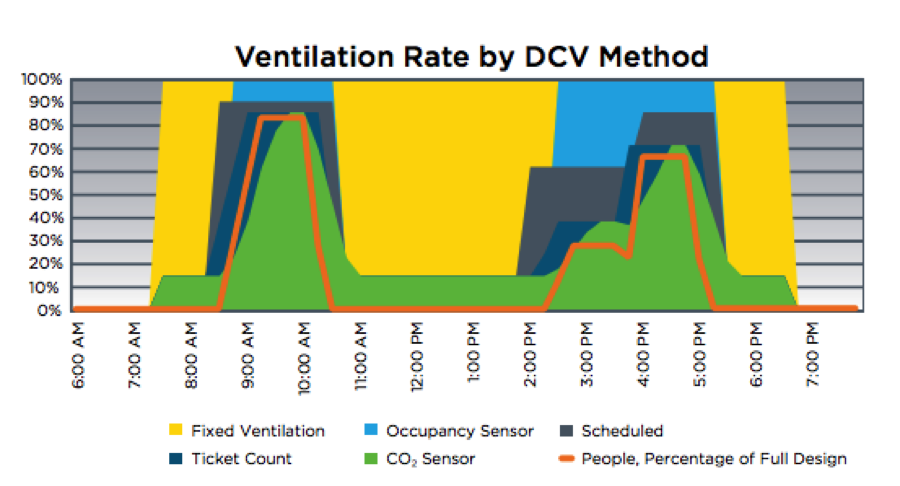
As you can see, in looking at the orange line, which indicates the flow of persons in the space, the CO2 sensing method most closely mimics their occupancy of the space. It’s been the preferred method for controlling the air mix for so long, you may have never stopped to consider what other alternatives a company might have, other than just setting the thermostat for particular hours of business or running it full blast all of the time.

As you’re engineering and installing these systems, take a moment to check out this quick checklist borrowed from ASHRAE (the American Society of Heating, Refrigeration and Air-Conditioning Engineers), to make sure you are in compliance with the ASHRAE Standard 61.1-2010 and 2012 IECC for occupant density spaces, and take these into consideration while planning your jobs.
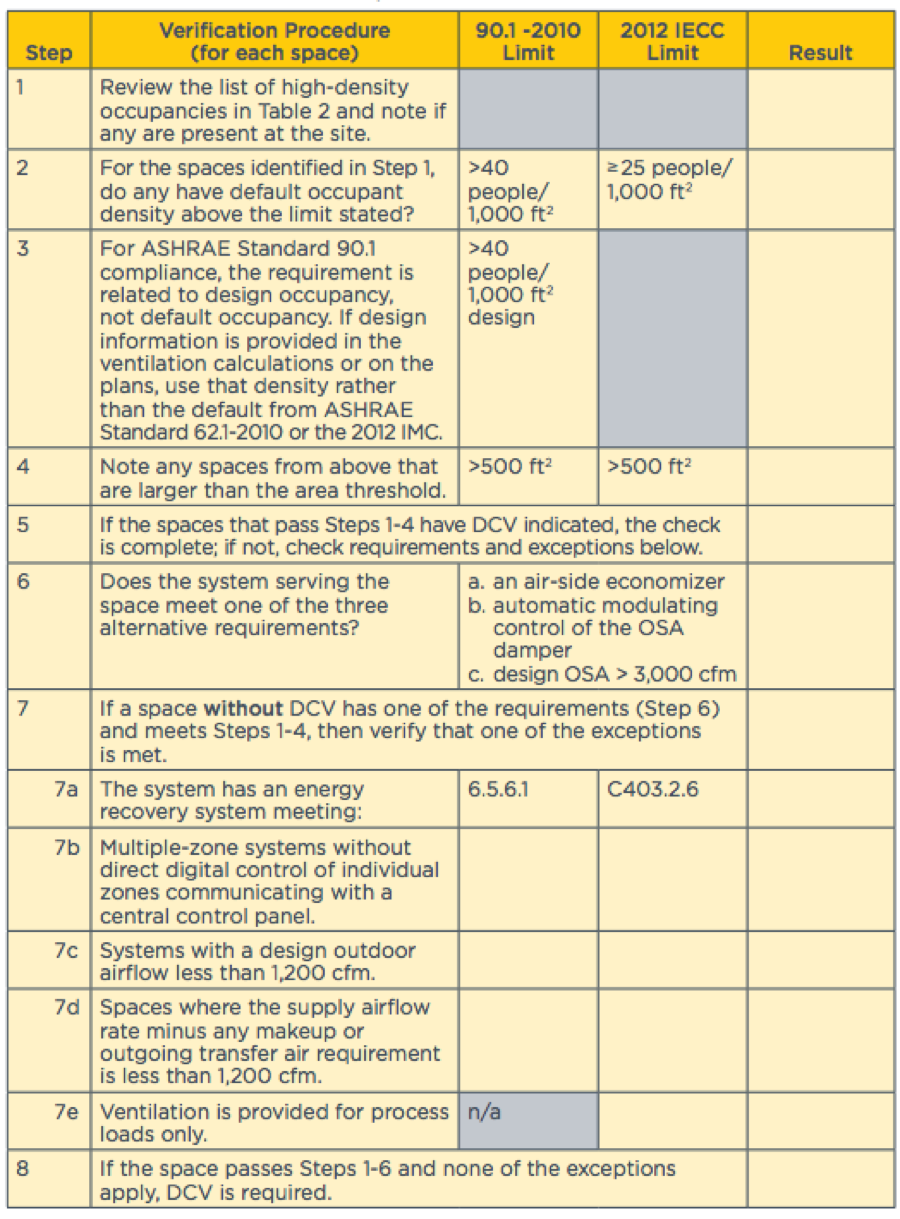
This next table below lists the default occupant densities by occupancy category from the 2012 IMC and ASHRAE Standard 62.1-2010 for high-density occupancies. Greyed areas are blank where the category exists in one ventilation standard and not the other. Greyed areas with numbers show the values from separate “referred to” or similar category groups in the same standard.

So, as a reminder, CO most likely won’t be in an office space, and unless you’re hosting a sardine party in your garage, you won’t need to sense CO2 there.  In the words of our Kele Product Manager,“CO is a car and CO2 are people.”
Q: The intrinsic safety spec I’m reading calls for an isolated ground. Isolated from what?

Answer: A true isolated ground is not connected to any ground that can ever carry fault current from unrelated parts of the electrical system. It is best to run it directly to grounded building structural steel, an underground metal water pipe, or a separate grounding electrode from the building electrical service as described in Article 250 of the National Electrical Code. However, many grounds that claim to be “isolated” are actually just separate wires run back to the ground bar on the nearest panelboard.  At best, they are run all the way back to the service entrance ground. In either of these cases, a high-current ground fault in the electrical system can raise the potential of the ground wire to destructive levels. True isolation is important for sensitive electronic devices, and is especially important in intrinsically safe systems where an explosion could result from a high voltage appearing on a ground conductor.

Temperature Sensor Curve ID Numbers


Need help figuring out what type sensor you need for your automation system?  This handy temperature curve chart might help.  If not, give Kele a call!


Sensor Type Temperature Sensor Description  Typical Sensor User
3 10,000Ω @ 77°F, Type III material    AET, American Automatrix, Andover, Carrier, Delta, Invensys, Teletrol, York
21 2252Ω @ 77°F, Type II material Anderson Cornelius, JCI (A319)
22 3000Ω @ 77°F, Type II material Alerton, ASI, ATS, Snyder General
24 10,000Ω @ 77°F, Type II material Alerton, Automated Logic, TAC (INET), Triangle Microsystems, Trane
27 100,000Ω @ 77°F, Type II material Siemens (Landis and Staefa)
42 20,000Ω @ 77°F, Type IV material Honeywell (XL)
63 1000Ω nickel RTD @ 70°F JCI
81 100Ω platinum RTD @ 32°F,
385 curve
Transmitter available for any user
85 1000Ω platinum RTD @ 32°F,
385 curve
JCI, Siemens, Trane (transmitter available for any user)
91 1000Ω platinum RTD @ 32°F,
375 curve
JCI, Trane (transmitter available for any user)
5 1000Ω Balco RTD @ 70°F TAC (Siebe) (transmitter available for any user)


Time Delay Relay Functions Explained

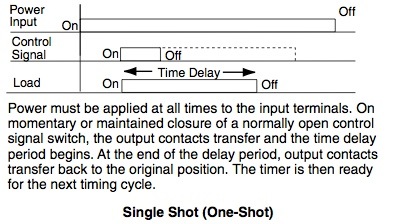
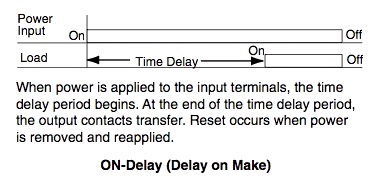
Understanding the differences between various time delay relay operations such as On-Delay or Interval can be a bit confusing.   These simple diagrams may make it easier to visualize what’s happening during the timer operation(s).


At Kele, our goal is to make product selection and usage as easy as possible.  Hopefully these simple diagrams make On-Delay, Off-Delay, Interval and One-shot time delay relay functions easy to understand.

Extend Your Reach with the ST-A Series by Precon

Kele’s Precon brand has a sensor solution for ALL your application needs, even the odd ones!

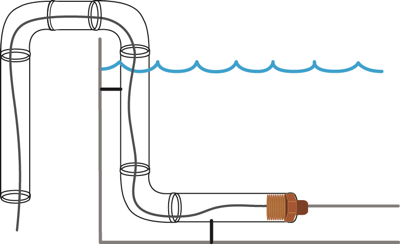
Job site situation #1: You need a temperature sensor for your tank or cooling tower sump, but they don’t make one long enough. Special ordering one seems daunting. What if it doesn’t work out and you can’t send it back? Precon has a solution for you. If your sensor probe isn’t long enough to reach your desired depth, create an extension! This solution allows you to measure the temperature without having to drain the tank or drill a hole. It also prevents you from having to buy a special length sensor and well. By simply creating a PVC pipe extender as shown below, and attaching Precon’s ST-A* temperature sensor to the other end, you’ve solved your unique application with a very simple, and in-stock (*) Precon sensor.

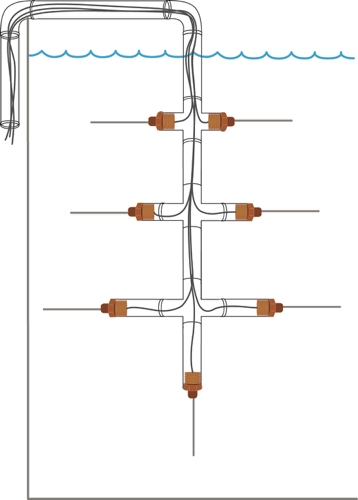
Job site situation #2: You need several sensors within the same well or tank, detecting the temperature throughout your pool. You can use a similar solution to the one shown above with just some additional PVC pipe as shown below. Run your wires through the pipe and affix the conduit to the side of your tank or well and voila! Precon solves another problem!

* ST-A sensors not typically requested may not be stocked.

Is Saving Energy Really that Hard to do? Apparently it is for Some?

As many of us have been told for years, programmable thermostats are worth their weight in gold when it comes to energy savings. Well, maybe not gold these days, but you get the point. According to the Department of Energy, heating and cooling costs are one of the largest expenses associated with commercial buildings. Savings from using a programmable thermostat can be impressive. Recent studies show that proper usage of a programmable thermostat can cut business’ heating costs by approximately 25%. In the summer, such devices may shave cooling costs 15 to 25%. In fact, according to the Department of Energy, on average, every degree raised on a thermostat in the summer or lowered in the winter, saves 2% on monthly energy spend.

So why is it that so many people are now stating there is no significant savings? That’s quite simple to answer; people don’t know how to program them or just don’t bother to! According to recent information released by the EPA, “Available studies indicate no savings from programmable thermostat installation. Some studies indicate slight increased consumption.” That is quite alarming given that programmable thermostats are supposed to decrease energy usage. As it turns out, they also stated that it is not necessarily the fault of the thermostat itself, but that people don’t use the programming functions properly on their thermostats. Most, according to the study, blame difficulty in programming as the reason for not using the thermostat properly. The EPA found that nearly 90% of programmable thermostats are used like a traditional manual thermostat in which occupants raise and lower the temperatures as they feel the need to change their comfort level. This can drive utility costs much higher than needed for building owners as the temperature setting doesn’t get changed back to a normal setting when people leave the building.

As BAS contractors and HVAC specialists, we certainly know that using a programmable thermostat saves energy. As shown above, it is very expensive to leave the temperature inside an office building constant day and night through the use of a manually operated thermostat. Programmable thermostats allow business owners to make adjustments for energy savings automatically.

So how do we change this trend? The best solution for now is to share the facts and educate your customer. Explain the overall benefits to them, but most importantly don’t just program their thermostat for them and walk away. Make them program it while you’re there and you can walk them through it. Not only does this give them peace of mind, it assures them that you understand the benefits and are looking out for their best interests.

Here are some basic tips you can share with your customers when showing them their newly installed thermostat:

  • When programming the thermostat, keep it set at a constant temperature for long periods of time, such as 12 to 14 hours when the space is not occupied.
  • When closed for a longer period of time such as holidays, set the hold button at a constant temperature. Or, with many of the new programmable thermostats you can set a holiday schedule.
  • Resist the urge to override the settings. Every time that is done it costs money. Installing thermostat guards can help prevent this as well.
  • If you have zoned heating and cooling, install a programmable thermostat in each zone. Especially if you have areas that are not occupied for long periods of time.
  • If your thermostat runs on batteries, change them at least once a year.

As we move into the next decade we face even more challenges when it comes to building automation and energy savings. Wireless technology is upon us and it is making a huge splash in the HVAC industry. Programmable thermostats are no stranger to this shift in technology as there are now many wireless options available. Also, the never ending trend of personalized control from smart phones and remote programming options has become part of most thermostat manufacturer’s standard portfolios. Kele has many of these in our offering and we can help with them as well.

All in all, the trend for most customers when it comes to programming thermostats and planning for energy savings is quite simple…make it simple and make it automated and they’ll follow those plans and guidelines. Well, the manufacturers’ are doing their part by making it automated. It’s up to us to continue to educate everyone to make it simple.

Green Buildings need Clean Electrical Power for Sustainability

Major changes are taking place in the United States as we all move forward to reduced energy consumption and utilization of renewable energy sources in our homes, offices, campus environments, and factories.

As new technology becomes available with ever increasing returns on investment many owners are ready to become part of the “Green Movement” that is currently taking place all across america. No question about it the time is right for all us to move forward with our Green initiatives.

With this in mind it is important to understand the goal here is to save money across all of our operating budgets. The two basic tenets of a green operation are energy efficiency and sustainability. In order for a building, process or product to be truly “green” it must achieve both of these goals.

There are many products and services available today that can dramatically reduce our consumption, improve our efficiencies, and supplement our energy sources. These new technologies VFDs, LED lighting, Building automation Systems, Solar generation, Battery Storage, to name a few all have one thing in common, they affect the the power distribution in our building in many ways. Many times it is a combination of these building changes that begin to interact with each other.

For example, having re-lamped an entire garage with LED lighting retrofits a hospital was pleased with the energy savings they were enjoying until they had failures of the lights due to to power quality issues in the building during generator operations. All of the energy savings were lost due to the cost of replacement electronics.

Sustainability of the equipment in our buildings is highly dependent on the Power Quality within our buildings. Many repairs or glitches within our systems can be traced back to power quality issues when adequate Power Quality Monitoring is done.

In the past it has been an expensive time consuming effort to have power quality surveys done in the buildings. Most cases these were done after the fact when problems had already caused major disruptions and equipment failures. This reactive method of understanding the Power Quality Dynamics of our building may have gotten us by years ago, but with all of the new changes taking place a more proactive real time Power Quality Monitoring Solution is needed.

The ability to install powerful “Real Time” Power Quality Meters with alarming functions and data collection is now highly cost effective and key to maintaining sustainability of our buildings. These PQUBE Power Quality meters are like the Black box recorder on an aircraft. They sit within the electrical cabinets and switchgear monitoring Power Quality 24/7 in real time.

Once an event is detected they generate alarms and reports as to what the event was, how long it lasted and most important they identify their location which is critical in understanding our buildings operations.

Taking only 30 min to install, and no software to learn the PQubes are the most cost effective and useable Power Quality Meters to date. Their small footprint (about the size of your hand) allow them to be retrofitted into existing electrical panels, transfer switches, and switchboards at many locations within your building.

As we make these major investments in green technologies it only makes sense that we know our buildings Power Quality, real time, all the time. PQube Power Quality meters put you ahead of problems before they become disasters.

Kele Services

Often times when people think of Kele they think of our huge product selection and availability. It’s true—not only does Kele provide nearly 60,000 products to choose from, we also have unlimited access to hundreds of thousands of product SKUs from over 300 of the industry’s premier manufacturers. But did you know that Kele has several services that could help drastically simplify your projects and workload? Here are some of our most used services:

1. Custom Panel Fabrication

Kele has been building custom panels for over 30 years and is an expert in panel layout, specification and assembly. We are here to help with your panel fabrication needs by providing parts for enclosures/panels from our $10 MILLION INVENTORY. Not only do we have the inventory to support your custom panel needs, we also thoroughly review all panel designs, perform quality control testing on every panel and have a short lead time. We stay flexible and our panel assembly team builds quality, tested panels to meet YOUR DEADLINE.

2. Custom Valve and Actuator Assembly

Kele’s Production Shop removes the guesswork from tedious product assembly. Most orders are assembled and shipped the same day—a free service to you from Kele. We offer the largest selection of valve and actuator brands in the business. In our custom valve assembly shop we can get your electric or pneumatic actuators professionally installed on our wide variety of 1/2″ to 6″ ball, zone, and globe valves. We also provide free tagging for easy identification when they arrive at your jobsite.

When it comes to customized assemblies, Kele also offers a wide selection of pressure transmitter assemblies with bypass valves, gauges and enclosures for protection during startup and maintenance, as well as protection against the environment. We also offer a variety of light assemblies for controls components, indicators, and labeling to make your peripheral components installation and maintenance easy.

3. Custom Calibration Solutions

At Kele, we use precision calibration equipment to set your specified signal ranges and engineering units. Most orders are calibrated and shipped the same day. Calibrated products include: differential pressure transmitters, temperature transmitters, output transducers, flow transmitters, power supplies, isolators, lighting contactor initiators and much more. Need help connecting your calibrated devices to the automation system—no problem. Our technical support team is available for any troubleshooting needs you may have.

4. Technical Experience

The whole idea of Kele started with the unique needs of BAS engineers and contractors in mind—an idea that has grown into 30 years of outstanding customer service and unmatched technical support. In fact, our client-facing, technical team has a total of 350 years combined experience.

One Source Solution

Kele’s entire business model is founded on the concept of providing a ‶one-stop solution”—where not only can you get EVERYTHING YOU NEED FROM ONE SUPPLIER, but have it shipped to you quickly and know that you have the technical support when you need it most. That’s why we not only provide our customers with the best product selection and availability in the industry, but we also offer several valuable services to help our customers simplify and streamline their projects.

For more information on the services Kele provides, please visit us on Kele.com or call 1-877-826-9045.

Coming Soon—New Kele.com & 2014-15 Kele Catalog

At Kele—we’re committed to providing you the best products, services and solutions in the building automation and HVAC/R industries. And we’re starting 2014 off with two new solutions that will help you get the job done right! In the first quarter we will be launching a new Kele.com and will be releasing our 2014-15 Kele catalog.

New Kele.com:
Fresh, sleek and easy-to-use are just some of the things people are saying to describe the new Kele.com. But we didn’t just update the look and feel of the site—once the site launches you’ll also find:
• New product landing pages and search functions to help you find the products you’re looking for faster,
• New product recommendations based on what you’re shopping for,
• A new video library to help stay ahead of the game,
• An enhanced cart and checkout process,
• And new line card and link shortcuts for quicker site navigation.

And don’t forget—online orders of $750 or more qualify for FREE SHIPPING!* So be on the lookout for the new Kele.com—you’ll be glad you did!

New 2014-15 Kele Catalog:
We may be biased, but the new 2014-15 Kele catalog is our best yet. When it comes to catalogs, Kele sets the industry standard. With this new catalog you’ll get:
• Information on 965 product families including 206 new product families,
• Easy-to-find wiring diagrams, dimensions and everything you need to spec a product,
• Valuable information on Kele’s services: in-house custom panel fabrication, custom valve and actuator assembly, custom calibrations, kitting and tagging,
• As well as valuable information on how Kele is your one-stop source for all of your building automation and HVAC/R needs.

The catalog should be ready to ship sometime in March 2014. Click here to request your new 2014-15 catalog today.


*Eligible in the 48 contiguous U.S. state only. Qualified customers only.

When the Controls Just Won’t Work

I have an old engineer friend I’ll call Bucky (not his real name). Bucky was burned years ago when he designed an HVAC system that turned out to have insufficient capacity to keep the building comfortable in winter. In fact, the perimeter offices were in the low 50s (°F) (low teens °C) when the first cold snap hit. When I say he was burned, I mean it figuratively – but the occupants of the building were thinking about burning him literally.

Well, old Bucky was not going to be burned again. We joke that the architect has to specify stronger door hardware when Bucky is doing the mechanical design, so that the doors don’t blow off the hinges from his absurd supply air quantities.

This leads to a control problem on Bucky-designed jobs. I had to install and program a building automation system for a Bucky job, and it wasn’t a good experience. How can one tune an office temperature control loop when the reheat box can warm the room faster than the temperature sensor can respond? The occupants would essentially be subjected to supply air temperature, which could reach 130°F (54°C) in heating mode.

I first went with my tried-and-true PID tuning method that I learned from a DuPont instrument engineer in the early 1980s. This method had never failed me until I tried it on Bucky’s HVAC system. I worked for a couple of hours on a single office but I could not get anything near stable control. I tried adding a feedforward loop to give the PID loop advance notice that the oversized hot water valve was about to open. That took programming time and it didn’t help at all.

So I went back to the office and batted the problem around with a group of my peers. We discussed, we calculated, we got out our controls books. We came to no good conclusion.

The next day, I programmed all of the interior spaces with no problem. There was way too much air but my tuning method resulted in stable control on the first pass. Then I went to ponder the perimeter offices again. As the building was approaching occupancy time, the painters were gone and the carpets were being installed. There happened to be a carpet layer in the office I went to first. I thought out loud for a minute, then I vented to him about what a pain the air system was for me. He sat up on his heels and listened, then said, “Seems to me there ought to be a way to reduce the air and water flows.”

I turned mighty red with embarrassment at that time. I thanked the carpet layer and went to call the test and balance fellows. They agreed to cut back on the water and air to the perimeter spaces if I could convince Bucky that I needed it. Well, Bucky came to the job site and it was pretty easy to convince him by getting him to stand in a perimeter office for a while. Problem solved, but not by me. They say that if your only tool is a hammer, then every problem looks like a nail. That was my problem in a nutshell. I was a controls guy, so I focused only on the controls.

The lessons I learned were: 1) Engineers can be wrong (yes, really!); 2) When a system can’t be tuned, the system might need fixing; and, 3) When all else fails, ask the carpet guy.