Kele Blog

Tech Talk: do you have a product that provides manual override if the controller does not support override capability?


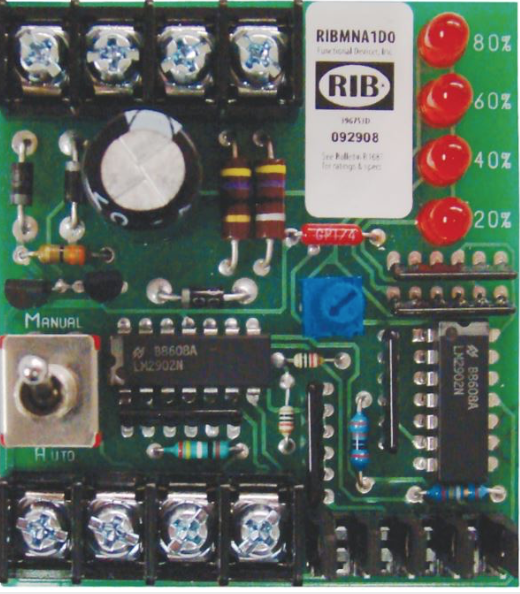
Most people that call Technical Support are aware of popular Functional Devices’ products like RIB® relays, current sensors, power supplies and transformers, but we offer many other products that do not fit into one of those categories. In this blog, I will spotlight one such product, model RIBMNA1D0.

Features

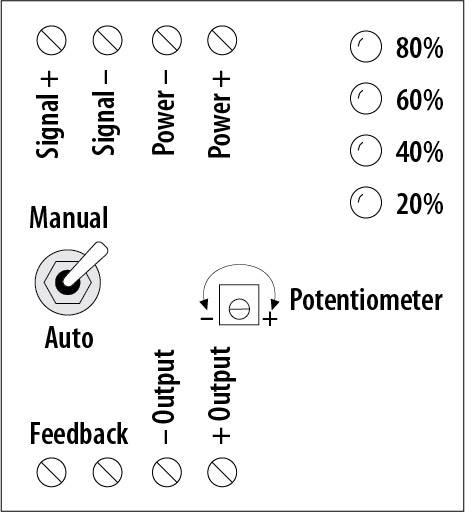
The RIBMNA1D0 is a track mountable, manual analog override switch, and it provides override feedback to a controller. This product allows the user to make manual adjustments to the control signal for an end device at the point of use, instead of back at the controller, which is great for testing and maintenance purposes. It offers four different analog output ranges (0-5Vdc, 0-10Vdc, 0-15Vdc and 0-20mA) selectable by jumpers, which will cover most analog control scenarios.

Function

The controller’s analog output would connect to the RIBMNA1D0’s Signal (+) and Signal (-), and the Output (+) and Output (-) would connect to the device being controlled. The jumpers would then be set to match the analog signal coming from the controller. In Auto mode, the device passes the signal from the controller on to the end device, and the Feedback contact will be Open. When manual override is needed, the switch is put in the Manual position, and the Feedback contact will Close. Now the analog signal to the end device is being generated by the RIBMNA1D0, and it can be adjusted with the on-board potentiometer. The LEDs on the board indicate the percentage of full scale that the output is at.

If the need for a manual analog override ever pops up in one of your projects, this product is just for you. 


Have more questions or not quite what you are looking for? Kele has an experienced technical support team you can call or email for help!

Industry Veteran Joins Kele…Meet Rob Benson!

Rob Benson joins Kele, Inc. as Chief Sales Officer, coming from the Johnson Controls field, branch, and regional network. Rob started his career as a sales engineer in Miami, Florida and continued gaining responsibility in leadership roles over 29 years with Johnson Controls. As a former customer, Rob appreciates Kele’s ability to positively impact the BAS contractor by simplifying their supply chain and delivering an unrivaled customer experience through personalized solutions, innovative technology, an unparalleled product offering, and world-class logistics.

“I was attracted to Kele because of the energy of the team and the momentum around creating a world-class customer experience, not yet seen in the building automation industry,” Benson said.

“I could not be more thrilled for Rob to join the Kele team. His experience leading high performing sales teams along with his knowledge of the HVAC construction process will enable Kele to deliver game-changing solutions for our customers in 2018,” said president and chief executive officer of Kele, Richard Campbell.


How Belimo butterfly control valves are helping mushrooms grow

In the production plant of Kuhn Champignons AG, seven to eight tons of mushrooms are produced daily. To accelerate the growth, an artificial “autumn climate” is created. Under the ideal temperature and humidity, the mushrooms grow, ripen and become ready for harvest within three weeks.

But after 30 years, the existing plant and hydraulics were obsolete and no longer met the current standards of sustainable production. Therefore, the entire plant had to be renewed for the purpose of saving energy and switching to variable amounts of water. Read more

Tech Talk: Air Capacity and Consumption – Choosing Electronic to Pneumatic Transducer

When it comes to selecting an electronic to pneumatic (E/P) transducer, the type of input and the pressure range of the output are the most common selection criteria considered. There are a couple of other specifications that are worth reviewing to select the best transducer for the job. These additional specifications are Air Consumption and Air Capacity. Read more

Tech Talk: Demand Control Ventilation

How many sensors are required in a typical installation? Where should they be located?

The number of zones with different occupancy patterns should dictate the number of sensors. In a small office application, for example, it would be ideal to have a sensor in the office space and one in the conference area. Carbon dioxide distribution in a space is influenced by the same factors that influence temperature distribution. These factors include convection, diffusion and mechanical air movement. Much like temperature sensors, placement of CO2 sensors should be based on the zone to be controlled and anticipated loads (e.g. common occupancy density and patterns). For optimum control, there should be a CO2 sensor placed in every location where temperatures controls are used. If an HVAC system is serving a series of zones with similar occupancy patterns, sensors placed in the return air ducting may be appropriate. Read more

A simple approach is the future of building automation systems

Thanks to improved wireless networking technology and standardized communication protocols, it’s easier than ever to collect data from sensors. Plus, silicon chips continue to get cheaper, faster and better and can be located in valves, actuators, thermostats and wall outlets to provide more memory and faster computing.

With the Internet of Things (IoT) continually expanding and easier access to cloud computing, it’s possible to transmit information, crunch numbers and use data like never before.

That means it’s time to take a fresh look at every element of a building — from small electrical switches, door locks and lights to massive chillers and boilers — as a way to gather and share information.

Most importantly, we need to re-examine the role of building automation systems (BAS) to enable the data and technology to merge and seamlessly solve problems in innovative ways, especially in smaller buildings.

Read more

Kele, Inc. Completes Acquisition of Control Consultants, Inc.

MEMPHIS, TN and BOSTON, MA – Kele, Inc. (Kele) announced today the acquisition of Control Consultants, Inc. (CCI). This strategic combination highlights each company’s long-term commitment to providing industry leading products and solutions to its customers. The combined entity will operate as separate brands, but will leverage the strengths each bring. Kele and CCI headquarters will remain in Memphis, Tenn. and Boston, respectively. Richard Campbell, current president and CEO of Kele, will serve as president and CEO of the combined company. Campbell has over 30 years of experience with commercial and industrial products, 27 of which were spent with Trane focused on heating, ventilation, and air conditioning (HVAC) and building automation systems (BAS). Read more

Tech Talk: High Output Voltage for Transformers

Q. My 75 VA 120:24 volt control transformer has a high output voltage. It reads as high as 28.3 volts with a 123 volt input. The load is only 8 VA on the transformer. Why is the output voltage so high?

A. A control transformer will have a higher output at a no-load or low load condition. A typical transformer with a 24 or 25 volt secondary rating will output 28 to 29 volts with no load. As the load increases, the output will lower to rated voltage at a full load. You need to either add load to the existing transformer or use a smaller VA transformer.

Read more

Staying Safe from High Voltage with Remote Current Sensor & Relay Combos

Problem

Here’s a scenario that may be familiar: the current of a high voltage load needs to be monitored with a current sensor, and the current sensor needs an integrated relay with 10A rated contacts. It seems easy, however when working with high voltage, some special equipment (and maybe even a licensed professional) is required. Fair enough, a professional is called to the scene to install the current sensor and relay combination. Everything is going well until it is discovered that the trip point on the current sensor is too high, and something needs to be adjusted! There’s no option but to get the licensed professional back out to the scene to make the small adjustment. This installation is taking a lot of time, and time means money. Read more

Building Automation and The Internet of Things

The Internet of Things (IoT) is changing the way people run their homes. More and more devices are becoming available to consumers that allow them to automate their thermostats and regulate their power consumption, often-times controlling these systems from the phone in their pocket. Products like the Nest thermostat and the Sense home energy monitor provide homeowners convenient tools that also help save utility costs. Read more